Back

Michael Addition definitions

Control buttons has been changed to "navigation" mode.
1/15
  • Michael Reaction

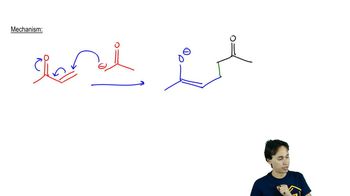
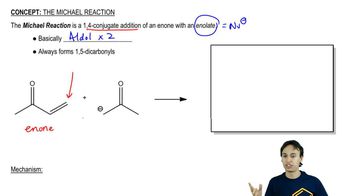
    A 1,4-conjugate addition where an enolate adds to an enone, forming a 1,5-dicarbonyl compound via a specific mechanism.
  • Conjugate Addition

    A process where a nucleophile adds to the beta position of an α,β-unsaturated carbonyl, often leading to stabilized products.
  • Enone

    A molecule containing a double bond conjugated to a carbonyl group, serving as the electrophile in certain addition reactions.
  • Enolate

    A resonance-stabilized anion formed by deprotonation of an alpha hydrogen next to a carbonyl, acting as a nucleophile.
  • 1,5-Dicarbonyl

    A compound featuring two carbonyl groups separated by three carbon atoms, typically the product of a Michael reaction.
  • Electrophile

    An atom or group with an electron deficiency, making it susceptible to attack by nucleophiles in organic mechanisms.
  • Nucleophile

    A species rich in electrons that seeks out electron-deficient centers, initiating bond formation in many reactions.
  • Tautomerization

    A chemical process where a compound rapidly interconverts between two isomers, typically involving proton shifts and double bond movement.
  • Enol

    A functional group featuring a hydroxyl attached to a carbon-carbon double bond, often an intermediate in tautomerization.
  • Keto Form

    The more stable tautomer of a carbonyl-containing compound, where the carbonyl group is present instead of an enol.
  • Vinyl Alcohol

    A less stable intermediate with a hydroxyl group bonded to a doubly bonded carbon, often quickly tautomerizing to a ketone.
  • Pi Bond

    A type of covalent bond formed by sideways overlap of p orbitals, present in double bonds and lost at the new connection in Michael addition.
  • Aldol Reaction

    A reaction forming a β-hydroxy carbonyl compound, conceptually related to the steps in the Michael reaction.
  • Resonance

    A phenomenon where electron density is delocalized across adjacent atoms, stabilizing intermediates in organic reactions.
  • Basic Environment

    A reaction condition where bases are present, facilitating enolate formation and subsequent tautomerization steps.