Back

Mass Spect:Isotopes quiz

Control buttons has been changed to "navigation" mode.
1/15
  • What is an isotope in the context of mass spectrometry?

    An isotope is an atom of the same element with a different number of neutrons, resulting in a different atomic mass.
  • Why are isotopes important in mass spectrometry?

    Isotopes are important because they cause peaks at different masses, which must be considered when analyzing mass spectra.
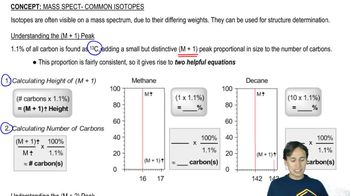
  • What causes the M+1 peak in a mass spectrum?

    The M+1 peak is caused by the presence of carbon-13 isotopes in the molecule.
  • How do you estimate the height of the M+1 peak for a compound?

    Multiply the number of carbons in the compound by 1.1%, which is the natural abundance of carbon-13.
  • If a molecule has 10 carbons, what is the estimated height of its M+1 peak?

    The estimated height is 11% of the molecular ion peak (10 × 1.1%).
  • How can you estimate the number of carbons in a molecule using the M+1 peak?

    Divide the height of the M+1 peak by the molecular ion peak, multiply by 100, and then divide by 1.1.
  • What is the significance of the M+2 peak in mass spectrometry?

    The M+2 peak is significant for identifying halogens like chlorine and bromine due to their distinctive isotopic patterns.
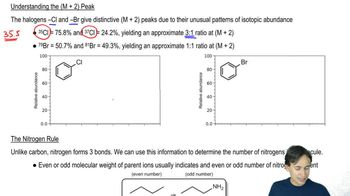
  • What is the typical M:M+2 ratio for chlorine in a mass spectrum?

    Chlorine shows a 3:1 ratio, with the M+2 peak being about one-third the height of the molecular ion peak.
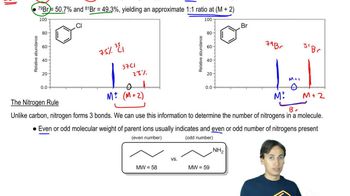
  • What is the typical M:M+2 ratio for bromine in a mass spectrum?

    Bromine shows a 1:1 ratio, with the M+2 peak being about the same height as the molecular ion peak.
  • Why does chlorine produce a 3:1 M:M+2 ratio in mass spectra?

    Because chlorine exists as about 75% Cl-35 and 25% Cl-37, leading to a 3:1 ratio of the two peaks.
  • Why does bromine produce a 1:1 M:M+2 ratio in mass spectra?

    Because bromine is nearly equally abundant as Br-79 and Br-81, resulting in equal peak heights.
  • What does the nitrogen rule state in mass spectrometry?

    The nitrogen rule states that an even molecular weight indicates an even number of nitrogens, while an odd molecular weight indicates an odd number of nitrogens.
  • How does replacing a carbon with a nitrogen affect the molecular weight of a compound?

    Replacing a carbon with a nitrogen increases the molecular weight by 2, but also changes the number of hydrogens due to nitrogen's bonding preferences.
  • If a molecule has an odd molecular weight, what does the nitrogen rule suggest?

    It suggests that the molecule contains an odd number of nitrogen atoms.
  • Why is the estimation of M+1 peak height less accurate for large molecules with many heteroatoms?

    Because other isotopes like nitrogen-15, sulfur, and phosphorus also contribute to the M+1 peak, making the simple carbon-based calculation less reliable.