Back

L and D Amino Acids quiz

Control buttons has been changed to "navigation" mode.
1/15
  • What configuration do standard amino acids in proteins typically have in biochemistry?

    Standard amino acids in proteins typically have the L configuration in biochemistry.
  • In organic chemistry, what is the equivalent of the L configuration for amino acids?

    In organic chemistry, the L configuration for amino acids is equivalent to the S configuration.
  • What is the biochemistry term for an amino acid with R configuration?

    An amino acid with R configuration is called a D amino acid in biochemistry.
  • Are D amino acids commonly found in proteins?

    No, D amino acids are not commonly found in proteins.
  • Why is it useful to visually recognize the configuration of amino acids instead of calculating R and S each time?

    It saves time and effort because amino acids are frequently encountered, making visual recognition more practical.
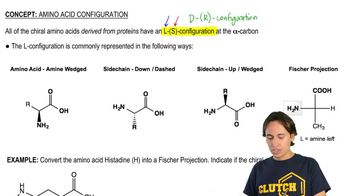
  • If the amine (NH2) group is facing down on a wedge in an amino acid structure, what configuration does it indicate?

    It indicates the S (L) configuration.
  • When the side chain (R group) is facing down on a dash, what configuration does the amino acid have?

    The amino acid has the S (L) configuration.
  • If the side chain (R group) is facing up on a wedge, what configuration does this represent?

    This also represents the S (L) configuration.
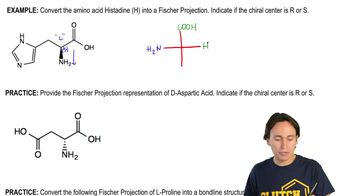
  • In a Fischer projection, where should the amine group be placed to indicate the L (S) configuration?

    The amine group should be placed on the left in a Fischer projection.
  • What is the mnemonic to remember the placement of the amine group for L configuration in Fischer projections?

    L is for left; place the amine group on the left.
  • In a Fischer projection of an amino acid, which group should be at the top?

    The most oxidized atom or the carboxylic acid group should be at the top.
  • What is the relationship between S and L configurations in amino acids found in proteins?

    In amino acids found in proteins, S configuration corresponds to the L configuration.
  • Do the L and S configurations always mean the same thing for all molecules?

    No, L and S configurations do not always mean the same thing for all molecules; this equivalence is specific to amino acids in proteins.
  • What is the enantiomer of the S (L) configuration amino acid called?

    The enantiomer is called the D (R) configuration amino acid.
  • Why is it not necessary to calculate R and S for every amino acid you encounter?

    Because you can use visual shortcuts to quickly identify the configuration, making calculations unnecessary for each case.