Back

Kumada Coupling Reaction definitions

Control buttons has been changed to "navigation" mode.
1/15
  • Kumada Coupling Reaction

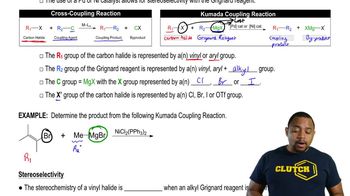
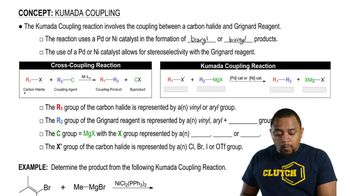
    A process joining a carbon halide and Grignard reagent using palladium or nickel catalysts to form new C–C bonds, often yielding biaryl or vinyl products.
  • Grignard Reagent

    An organomagnesium compound, typically R–MgX, acting as a nucleophile in coupling reactions to form new carbon–carbon bonds.
  • Carbon Halide

    An organic molecule containing a carbon atom bonded to a halogen, serving as a key reactant in cross-coupling processes.
  • Palladium Catalyst

    A transition metal complex that accelerates coupling reactions, enabling control over product configuration and yield.
  • Nickel Catalyst

    A transition metal complex used to facilitate the coupling of carbon halides and Grignard reagents, often as an alternative to palladium.
  • Biaryl Product

    A molecule consisting of two aromatic rings directly connected, commonly formed as a major product in coupling reactions.
  • Vinyl Product

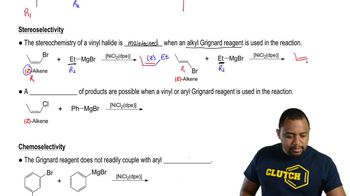
    A compound featuring a carbon–carbon double bond, often retaining the original stereochemistry from the starting vinyl halide.
  • Stereochemistry

    The spatial arrangement of atoms in molecules, crucial for determining E/Z configurations in coupling products.
  • E/Z Configuration

    A notation describing the relative positions of substituents around a double bond, preserved or altered during coupling.
  • Chemo Selectivity

    The preference of a reaction to occur at one functional group over another, such as favoring bromine over chlorine in aryl halides.
  • Aryl Halide

    An aromatic ring bonded to a halogen, serving as a substrate in coupling reactions but showing variable reactivity.
  • Vinyl Halide

    A molecule containing a halogen attached to an alkene carbon, often used to control product stereochemistry in couplings.
  • Byproduct

    A secondary substance formed during the reaction, typically a halide or magnesium halide, which is discarded.
  • Transition Metal Catalyst

    A metal complex, such as palladium or nickel, that enables and controls the coupling of organic fragments.
  • Cross Coupling Reaction

    A general class of reactions where two different organic groups are joined via a metal-catalyzed process.