Back

IR Spect:Drawing Spectra quiz

Control buttons has been changed to "navigation" mode.
1/15
  • What is the typical shape and location of the sp3 C-H absorption in an alkane IR spectrum?

    The sp3 C-H absorption appears as a choppy peak around 2900 cm-1 due to overlapping signals from many hydrogens.
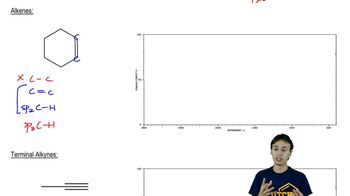
  • How does the IR spectrum of an alkene differ from that of an alkane?

    Alkenes show a weak, sharp peak at 1600 cm-1 (C=C) and choppy peaks both before and after 3000 cm-1 due to sp3 and sp2 C-H bonds.
  • Where does the sp C-H stretch of a terminal alkyne appear in an IR spectrum, and what is its shape?

    The sp C-H stretch appears as a strong, sharp peak at 3300 cm-1 because there is only one hydrogen causing the absorption.
  • What is the characteristic absorption of a C≡C triple bond in a terminal alkyne, and how does it appear?

    The C≡C triple bond shows a weak to medium, sharp peak around 2200 cm-1.
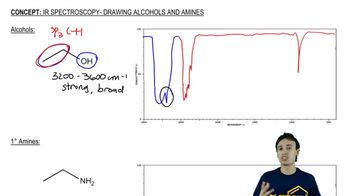
  • Describe the IR absorption of an alcohol O-H stretch in terms of range and shape.

    The O-H stretch in alcohols is strong and broad, spanning from 3200 to 3600 cm-1, often overshadowing other peaks in this region.
  • How can the presence of both an alcohol and a terminal alkyne affect the IR spectrum in the 3200–3600 cm-1 region?

    The broad alcohol peak can obscure the sharp alkyne peak, making the alkyne absorption appear as a small protrusion within the alcohol's broad absorption.
  • How many N-H absorptions are expected for a primary amine, and why?

    A primary amine shows two weak, sharp peaks (around 3300 and 3400 cm-1) due to symmetrical and asymmetrical N-H stretching vibrations.
  • What distinguishes the IR absorption of a secondary amine from a primary amine?

    A secondary amine has only one N-H and thus shows a single weak, sharp peak around 3300 cm-1.
  • Why do tertiary amines not show N-H absorptions in the functional group region of IR spectra?

    Tertiary amines lack N-H bonds, so they do not produce absorptions in the functional group region.
  • At what wavenumber does a ketone C=O stretch typically appear, and what is its shape?

    A ketone C=O stretch appears as a strong, sharp peak around 1710 cm-1.
  • How does the IR absorption of an ester C=O compare to that of a ketone?

    An ester C=O stretch is also strong and sharp but appears at a slightly higher wavenumber, around 1750 cm-1.
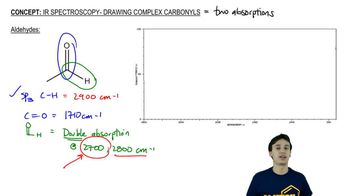
  • What additional absorption is characteristic of an aldehyde in IR spectroscopy?

    Aldehydes show a double peak around 2700 cm-1 due to the aldehyde C-H stretch, in addition to the strong C=O peak at 1710 cm-1.
  • Describe the O-H absorption of a carboxylic acid in terms of range and shape.

    The O-H absorption in carboxylic acids is very broad and strong, starting around 2500 cm-1 and sometimes extending up to 3300 cm-1.
  • Why do alkyl halides, ethers, and tertiary amines appear similar to alkanes in the IR functional group region?

    They lack double or triple bonds and bonds to hydrogen in the functional group region, so only the sp3 C-H absorption is visible, making them indistinguishable from alkanes.
  • What is a limitation of IR spectroscopy when identifying certain functional groups?

    IR spectroscopy cannot reliably identify groups like alkyl halides, ethers, and tertiary amines because their characteristic absorptions fall in the fingerprint region or are absent in the functional group region.