Back

Intro to Phosphate Anhydrides definitions

Control buttons has been changed to "navigation" mode.
1/15
  • Phosphate Anhydride

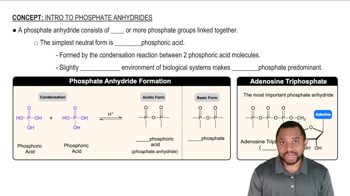
    Compound with two or more phosphate groups linked together, crucial in energy transfer within biological systems.
  • Pyrophosphoric Acid

    Simplest neutral form created by condensation of two phosphoric acid molecules, featuring protonated hydroxyl groups.
  • Condensation Reaction

    Process where two molecules join, releasing water, often forming larger molecules like pyrophosphoric acid.
  • Phosphoric Acid

    Starting material for forming phosphate anhydrides, containing phosphorus, oxygen, and hydrogen atoms.
  • Pyrophosphate

    Deprotonated form of pyrophosphoric acid, predominates in slightly basic biological environments with negative oxygens.
  • ATP

    Molecule with a phosphate anhydride portion, central to cellular energy transfer, containing three phosphate groups.
  • ADP

    Molecule similar to ATP but with two phosphate groups, formed by loss of one phosphate from ATP.
  • Alkylated Phosphate Anhydride

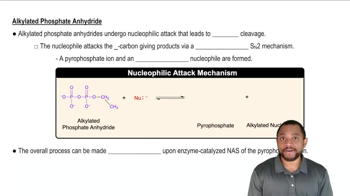
    Phosphate anhydride with an attached alkyl group, subject to nucleophilic attack at the alpha carbon.
  • Nucleophile

    Species that donates an electron pair to form a new bond, attacking the alpha carbon in alkylated phosphate anhydrides.
  • Alpha Carbon

    Carbon atom directly bonded to the oxygen in an alkylated phosphate anhydride, site of nucleophilic attack.
  • Pyrophosphate Ion

    Negatively charged species formed after nucleophilic attack on an alkylated phosphate anhydride, can act as a nucleophile.
  • Nucleophilic Acyl Substitution

    Enzyme-catalyzed process making the reaction with pyrophosphate ion irreversible by preventing reformation of reactants.
  • Anhydride

    Functional group with two acyl or phosphoryl groups linked by an oxygen atom, central to energy-rich bonds.
  • Ribose

    Five-membered sugar ring present in ATP, forming part of its backbone structure.
  • Adenine

    Nitrogenous base attached to ribose in ATP and ADP, essential for nucleotide structure.