Skip to main content
Organic Chemistry
My Course
Learn
Exam Prep
AI Tutor
Study Guides
Textbook Solutions
Flashcards
Explore
Try the app
My Course
Learn
Exam Prep
AI Tutor
Study Guides
Textbook Solutions
Flashcards
Explore
Try the app
Back
Intro to Nucleic Acids definitions
You can tap to flip the card.
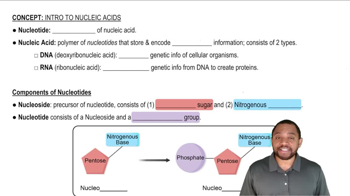
Nucleotide
You can tap to flip the card.
👆
Nucleotide
Monomer unit of nucleic acids, composed of a phosphate group, pentose sugar, and nitrogenous base.
Track progress
Control buttons has been changed to "navigation" mode.
1/15
Related flashcards
Related practice
Recommended videos
Intro to Nucleic Acids quiz #1
Intro to Nucleic Acids
40 Terms
Intro to Nucleic Acids quiz #2
Intro to Nucleic Acids
39 Terms
Intro to Nucleic Acids quiz #3
Intro to Nucleic Acids
39 Terms
Intro to Nucleic Acids
34. Nucleic Acids
5 problems
Topic
Nitrogenous Bases
34. Nucleic Acids
5 problems
Topic
34. Nucleic Acids - Part 1 of 2
4 topics
12 problems
Chapter
34. Nucleic Acids - Part 2 of 2
3 topics
9 problems
Chapter
Guided course
1:34
Intro to Nucleic Acids Concept 2
4
views
Guided course
1:11
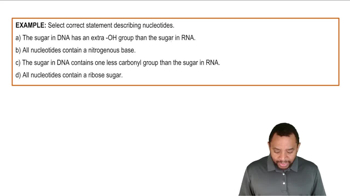
Intro to Nucleic Acids Example 1
3
views
Guided course
1:55
Intro to Nucleic Acids Concept 1
2
views
Terms in this set (15)
Hide definitions
Nucleotide
Monomer unit of nucleic acids, composed of a phosphate group, pentose sugar, and nitrogenous base.
Nucleic Acid
Polymer of nucleotides responsible for storing and encoding genetic information in cells.
DNA
Type of nucleic acid that stores genetic information using deoxyribose as its pentose sugar.
RNA
Type of nucleic acid that transfers genetic information for protein synthesis, containing ribose sugar.
Nucleoside
Molecule consisting of a pentose sugar bonded to a nitrogenous base, lacking a phosphate group.
Phosphate Group
Component of nucleotides that links to the pentose sugar, enabling chain formation in nucleic acids.
Pentose Sugar
Five-carbon sugar present in nucleotides, determining whether the molecule is DNA or RNA.
Nitrogenous Base
Molecule attached to the pentose sugar in nucleotides, essential for encoding genetic information.
Ribose
Pentose sugar in RNA nucleotides, distinguished by the presence of an OH group on the 2' carbon.
Deoxyribose
Pentose sugar in DNA nucleotides, lacking an oxygen atom at the 2' position, resulting in just an H.
Genetic Information
Encoded instructions within nucleic acids that determine cellular structure and function.
Polymer
Large molecule formed by repeated linking of monomer units, such as nucleotides in nucleic acids.
Monomer
Single, repeating unit that joins with others to form a polymer, such as a nucleotide in nucleic acids.
Protein Synthesis
Cellular process where genetic information from RNA is used to assemble amino acids into proteins.
Deoxy
Descriptor indicating the absence of an oxygen atom, as seen in the sugar component of DNA.
 BackBack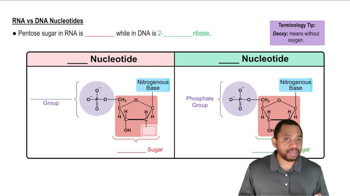
 1:34
1:34