Organic Chemistry
My Course
Learn
Exam Prep
AI Tutor
Study Guides
Textbook Solutions
Flashcards
Explore
Try the app
My Course
Learn
Exam Prep
AI Tutor
Study Guides
Textbook Solutions
Flashcards
Explore
Try the app
Back
Intro to Citric Acid Cycle definitions
You can tap to flip the card.
Citric Acid Cycle
You can tap to flip the card.
👆
Citric Acid Cycle
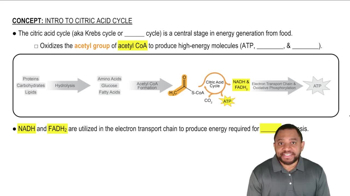
A central metabolic pathway that oxidizes acetyl groups to generate high-energy molecules and carbon dioxide in a cyclic sequence.
Track progress
Control buttons has been changed to "navigation" mode.
1/15
Related flashcards
Recommended videos
Intro to Citric Acid Cycle quiz
Intro to Citric Acid Cycle
10 Terms
1:40
Intro to Citric Acid Cycle Concept 2
3
views
2:21
Intro to Citric Acid Cycle Concept 1
3
views
1:11
Intro to Citric Acid Cycle Example 2
4
views
Terms in this set (15)
Hide definitions
Citric Acid Cycle
A central metabolic pathway that oxidizes acetyl groups to generate high-energy molecules and carbon dioxide in a cyclic sequence.
Krebs Cycle
Another name for the main energy-yielding cycle in cellular respiration, synonymous with the Citric Acid Cycle.
TCA Cycle
A term highlighting the tricarboxylic acid nature of the cycle, emphasizing its role in energy metabolism.
Acetyl CoA
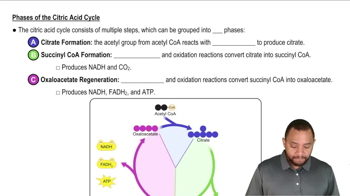
A two-carbon molecule that initiates the cycle by combining with oxaloacetate to form citrate.
Oxaloacetate
A four-carbon compound that reacts with acetyl groups to start the cycle and is regenerated at the end.
Citrate
A six-carbon intermediate formed from acetyl CoA and oxaloacetate, marking the cycle's entry point.
Succinyl CoA
A key intermediate produced after citrate isomerization and oxidation, leading to further energy extraction.
NADH
A high-energy electron carrier generated during the cycle, later used in the electron transport chain for ATP production.
FADH2
An electron carrier produced in the cycle, contributing electrons to the electron transport chain for energy synthesis.
ATP
The primary energy currency of the cell, directly produced in the cycle and in larger amounts via subsequent pathways.
Electron Transport Chain
A series of protein complexes that use electrons from NADH and FADH2 to drive ATP synthesis.
Catabolism
The breakdown of macromolecules into smaller units, ultimately feeding substrates into the cycle for energy extraction.
Hydrolysis
A chemical process that splits macromolecules into monomers, providing substrates for acetyl CoA formation.
Oxidation
A reaction type in the cycle where electrons are removed from intermediates, facilitating energy carrier production.
Carbon Dioxide
A waste product released during the cycle as acetyl groups are fully oxidized.