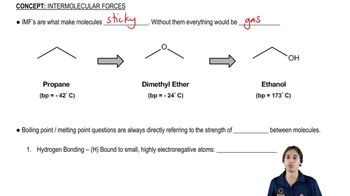
Attractive interactions between separate molecules, responsible for holding substances together as solids or liquids without altering their chemical identity.
Hydrogen Bonding
A strong attraction involving hydrogen attached to nitrogen, oxygen, or fluorine, leading to unusually high boiling and melting points in substances like water.
Dipole-Dipole Forces
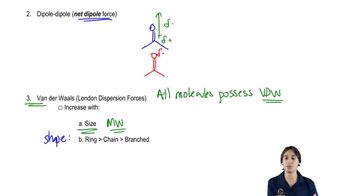
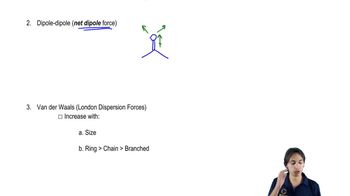
Attractions between molecules with permanent net dipole moments, aligning partial positive and negative regions to increase boiling and melting points.
Van der Waals Forces
Weak, universal attractions present in all molecules, whose strength increases with molecular weight and symmetry, affecting physical properties.
Boiling Point
The temperature at which a substance transitions from liquid to gas, heavily influenced by the strength of intermolecular attractions.
Melting Point
The temperature at which a solid becomes a liquid, determined by how strongly molecules attract each other in the solid state.
Molecular Weight
A measure of the mass of a molecule, with higher values generally leading to stronger Van der Waals attractions and higher boiling points.
Symmetry
A structural feature allowing molecules to stack efficiently, enhancing Van der Waals attractions and increasing boiling and melting points.
Partial Charge
A region of slight positive or negative character within a molecule, resulting from unequal electron sharing and enabling dipole interactions.
Chemical Bond
A strong connection within a molecule, distinct from intermolecular attractions, responsible for holding atoms together in a compound.
Aggregation
The process by which molecules cluster together due to intermolecular attractions, allowing the existence of liquids and solids.
Volatility
A property describing how easily a substance vaporizes, with weaker intermolecular attractions leading to higher volatility.
Net Dipole
The overall polarity of a molecule resulting from the vector sum of individual bond dipoles, necessary for dipole-dipole attractions.
Electronegativity
A tendency of an atom to attract electrons, with high values in nitrogen, oxygen, and fluorine enabling strong hydrogen bonding.
Branching
A molecular feature where chains split, reducing the ability to stack and thus weakening Van der Waals attractions.
 Back
Back

 01:46
01:46