Back

Hydrolysis of Phosphate Esters definitions

Control buttons has been changed to "navigation" mode.
1/15
  • Phosphate Ion

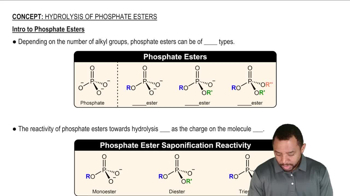
    A central phosphorus atom bonded to four oxygens, carrying a -3 charge, and exhibiting resonance structures.
  • Monoester

    A phosphate ester with a single alkyl group attached to the phosphate ion, showing the lowest reactivity toward hydrolysis.
  • Diester

    A phosphate ester with two alkyl groups attached, displaying intermediate reactivity in hydrolysis reactions.
  • Triester

    A phosphate ester with three alkyl groups, exhibiting the highest reactivity toward hydrolysis due to minimal charge.
  • Saponification

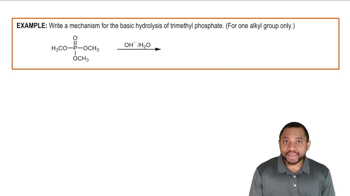
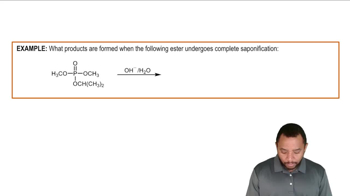
    A basic hydrolysis process, especially of phosphate triesters, leading to bond cleavage and formation of new products.
  • Phosphorus-Oxygen Bond Cleavage

    A mechanism where a nucleophile attacks phosphorus, forming a penta coordinated complex before releasing an alkoxide.
  • Carbon-Oxygen Bond Cleavage

    A mechanism where hydroxide attacks the alpha carbon, resulting in a single-step SN2 reaction yielding dialkyl phosphate and alcohol.
  • Nucleophile

    A species, such as hydroxide ion, that donates an electron pair to attack electrophilic centers like phosphorus or carbon.
  • Penta Coordinated Complex

    A trigonal bipyramidal intermediate formed when phosphorus is temporarily bonded to five groups during hydrolysis.
  • Alkoxide

    A leaving group generated during bond cleavage, consisting of an oxygen atom bonded to an alkyl group and carrying a negative charge.
  • Dialkyl Phosphate

    A product formed after carbon-oxygen bond cleavage, containing two alkyl groups attached to a phosphate moiety.
  • Hydroxide Ion

    A strong nucleophile that initiates hydrolysis by attacking phosphorus or carbon atoms in phosphate esters.
  • Alpha Carbon

    The carbon atom directly bonded to the oxygen in an alkyl group, targeted during SN2 reactions in hydrolysis.
  • Resonance Structures

    Alternative Lewis structures representing electron delocalization in the phosphate ion, stabilizing its charge.
  • SN2 Mechanism

    A single-step substitution process where a nucleophile attacks an electrophilic carbon, leading to bond inversion.