Skip to main content
Organic Chemistry
My Course
Learn
Exam Prep
AI Tutor
Study Guides
Textbook Solutions
Flashcards
Explore
Try the app
My Course
Learn
Exam Prep
AI Tutor
Study Guides
Textbook Solutions
Flashcards
Explore
Try the app
Back
Hydrolysis of Nucleosides definitions
You can tap to flip the card.
Nucleoside
You can tap to flip the card.
👆
Nucleoside
A molecule composed of a nitrogenous base linked to a sugar, lacking phosphate groups, and resistant to mild hydrolysis.
Track progress
Control buttons has been changed to "navigation" mode.
1/12
Related flashcards
Related practice
Recommended videos
Hydrolysis of Nucleosides quiz
Hydrolysis of Nucleosides
10 Terms
Hydrolysis of Nucleosides
34. Nucleic Acids
5 problems
Topic
Primary Structure of Nucleic Acids
34. Nucleic Acids
5 problems
Topic
34. Nucleic Acids - Part 1 of 2
4 topics
12 problems
Chapter
34. Nucleic Acids - Part 2 of 2
3 topics
9 problems
Chapter
Guided course
5:52
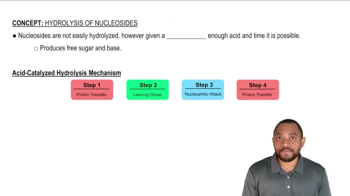
Hydrolysis of Nucleosides Example 1
2
views
Guided course
0:55
Hydrolysis of Nucleosides Concept 1
4
views
Terms in this set (12)
Hide definitions
Nucleoside
A molecule composed of a nitrogenous base linked to a sugar, lacking phosphate groups, and resistant to mild hydrolysis.
Hydrolysis
A chemical process where a compound is cleaved by reaction with water, often requiring acidic conditions for nucleosides.
Nitrogenous Base
A heterocyclic aromatic compound released from nucleosides during hydrolysis, essential for genetic coding.
Sugar
A carbohydrate moiety liberated from nucleosides upon hydrolysis, forming the backbone of nucleic acids.
Acid-Catalyzed Mechanism
A reaction pathway facilitated by strong acid, enabling otherwise slow hydrolysis of nucleosides.
Proton Transfer
A step involving movement of a hydrogen ion, crucial for activating or stabilizing intermediates in the mechanism.
Leaving Group
An atom or group that departs with a pair of electrons during a reaction, enabling bond cleavage in nucleoside hydrolysis.
Nucleophilic Attack
A step where an electron-rich species forms a new bond with an electron-deficient center, advancing the reaction.
Mechanism
A sequence of elementary steps detailing how reactants are converted to products in a chemical reaction.
Strong Acid
A substance capable of donating protons readily, necessary to initiate nucleoside hydrolysis.
Intermediate
A transient species formed during the multi-step conversion of nucleosides to products.
Acidic Hydrolysis
A process where water and acid together cleave chemical bonds, specifically in nucleosides.
 BackBack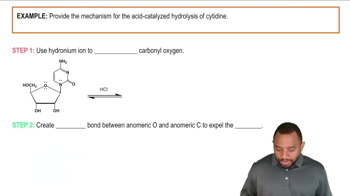
 5:52
5:52