Skip to main content
Organic Chemistry
My Course
Learn
Exam Prep
AI Tutor
Study Guides
Textbook Solutions
Flashcards
Explore
Try the app
My Course
Learn
Exam Prep
AI Tutor
Study Guides
Textbook Solutions
Flashcards
Explore
Try the app
Back
Hydrogenation of Alkynes definitions
You can tap to flip the card.
Hydrogenation
You can tap to flip the card.
👆
Hydrogenation
A reaction type that increases hydrocarbon saturation by adding hydrogens to multiple bonds, altering both structure and stereochemistry.
Track progress
Control buttons has been changed to "navigation" mode.
1/14
Related flashcards
Related practice
Recommended videos
Hydrogenation of Alkynes quiz #1
Hydrogenation of Alkynes
10 Terms
Hydrogenation of Alkynes
9. Alkenes and Alkynes
7 problems
Topic
Johnny
Dehydration Reaction
9. Alkenes and Alkynes
7 problems
Topic
Ernest
9. Alkenes and Alkynes - Part 1 of 2
5 topics
11 problems
Chapter
Ernest
9. Alkenes and Alkynes - Part 2 of 2
5 topics
11 problems
Chapter
Johnny
06:08
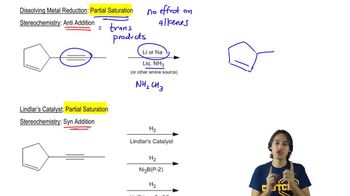
Using Dissolving Metal Reduction or Lindlar’s Catalyst to turn alkynes to alkenes.
4
views
03:46
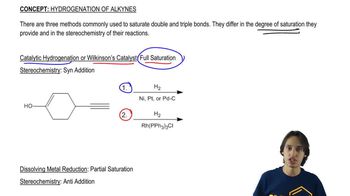
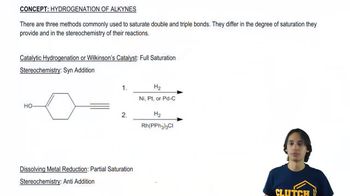
Using Catalytic hydrogenation or Wilkinson’s Catalyst to turn alkynes to alkanes.
5
views
00:48
The definition of hydrogenation.
7
views
Terms in this set (14)
Hide definitions
Hydrogenation
A reaction type that increases hydrocarbon saturation by adding hydrogens to multiple bonds, altering both structure and stereochemistry.
Saturation
A measure of how many hydrogens are present in a hydrocarbon, with higher values indicating fewer multiple bonds.
Catalytic Hydrogenation
A process using H2 and a metal catalyst like platinum, palladium, or nickel to fully convert multiple bonds into single bonds.
Wilkinson's Catalyst
A rhodium-based complex with triphenylphosphine and chlorine, used with H2 to fully saturate double or triple bonds.
Syn Addition
A stereochemical outcome where two substituents add to the same side of a double or triple bond, often yielding cis products.
Partial Saturation
A transformation that converts triple bonds to double bonds, leaving existing double bonds unaffected.
Dissolving Metal Reduction
A reaction using sodium or lithium in liquid amine to reduce triple bonds to trans double bonds via anti addition.
Anti Addition
A stereochemical process where two substituents add to opposite sides of a multiple bond, resulting in trans products.
Lindlar's Catalyst
A poisoned catalyst, often with lead acetate and quinoline, that enables syn addition to triple bonds, forming cis double bonds.
Poisoned Catalyst
A catalyst modified to halt hydrogenation at the double bond stage, preventing full reduction to single bonds.
Trans Double Bond
A double bond configuration where substituents are on opposite sides, typically formed via anti addition.
Cis Double Bond
A double bond configuration with substituents on the same side, commonly produced by syn addition.
Sigma Framework
The arrangement of single bonds in a molecule, which remains unchanged during hydrogenation except for the conversion of multiple bonds.
Pi Bond
A component of double or triple bonds that is removed during hydrogenation, increasing molecular saturation.
 BackBack

 06:08
06:08