Skip to main content
Organic Chemistry
My Course
Learn
Exam Prep
AI Tutor
Study Guides
Textbook Solutions
Flashcards
Explore
Try the app
My Course
Learn
Exam Prep
AI Tutor
Study Guides
Textbook Solutions
Flashcards
Explore
Try the app
Back
Hofmann Rearrangement quiz
You can tap to flip the card.
What is the main purpose of the Hofmann rearrangement reaction?
You can tap to flip the card.
👆
What is the main purpose of the Hofmann rearrangement reaction?
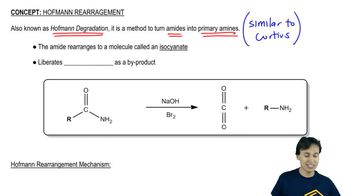
The Hofmann rearrangement converts amides into primary amines.
Track progress
Control buttons has been changed to "navigation" mode.
1/15
Related flashcards
Related practice
Recommended videos
Hofmann Rearrangement definitions
Hofmann Rearrangement
14 Terms
Hofmann Rearrangement
26. Amines
5 problems
Topic
Hofmann Elimination
26. Amines
2 problems
Topic
Johnny
23. Amines - Part 1 of 3
4 topics
11 problems
Chapter
Nicole
23. Amines - Part 2 of 3
5 topics
13 problems
Chapter
Nicole
26. Amines - Part 3 of 3
1 topic
3 problems
Chapter
Guided course
07:18
Mechanism
4
views
Guided course
02:51
General Reaction
5
views
Terms in this set (15)
Hide definitions
What is the main purpose of the Hofmann rearrangement reaction?
The Hofmann rearrangement converts amides into primary amines.
What is another name for the Hofmann rearrangement?
It is also known as the Hofmann degradation.
What type of compound is used as the starting material in the Hofmann rearrangement?
An amide is used as the starting material.
Which two reagents are essential for the Hofmann rearrangement?
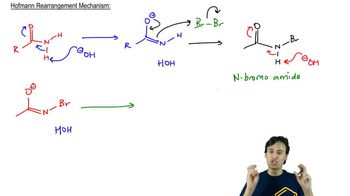
A base (commonly sodium hydroxide) and bromine (Br2) are essential.
What intermediate is formed during the Hofmann rearrangement before the final amine product?
An isocyanate intermediate is formed.
What gas is released as a byproduct during the Hofmann rearrangement?
Carbon dioxide (CO2) is released as a byproduct.
What is the role of the base in the first step of the Hofmann rearrangement?
The base deprotonates the amide, making it nucleophilic.
What is the name of the intermediate formed after the amide reacts with bromine?
The intermediate is called an N-bromoamide.
During the rearrangement step, what group migrates to the nitrogen atom?
The R group attached to the carbonyl carbon migrates to the nitrogen.
What happens to the carbonyl group during the Hofmann rearrangement?
The carbonyl group is removed as CO2 during decarboxylation.
What is the final organic product of the Hofmann rearrangement?
The final organic product is a primary amine.
What other byproduct, besides CO2, is formed during the Hofmann rearrangement?
Water is also formed as a byproduct.
Which atom in the isocyanate intermediate is most electrophilic and attacked by the base?
The carbon atom in the isocyanate is the most electrophilic and is attacked by the base.
How is the Hofmann rearrangement similar to the Curtius rearrangement?
Both involve a rearrangement step and the formation of an isocyanate intermediate, with CO2 as a byproduct.
Why is the Hofmann rearrangement considered a degradation reaction?
It is called a degradation because it removes a carbon atom from the original amide, reducing its carbon count.
 BackBack

 07:18
07:18