Back

Hemiacetal definitions

Control buttons has been changed to "navigation" mode.
1/15
  • Hemiacetal

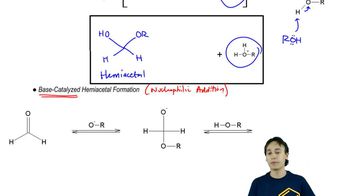
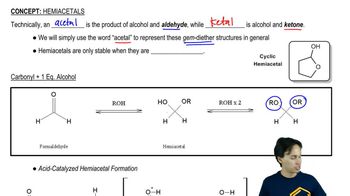
    A functional group with both an alcohol and an ether attached to the same carbon, typically stable only in cyclic forms.
  • Acetal

    A compound where a central carbon is bonded to two ether groups in the geminal position, formed from further reaction of a hemiacetal.
  • Hemiketal

    A structure similar to a hemiacetal but derived from a ketone, often grouped under the same terminology due to similar reactivity.
  • Ketal

    A compound analogous to an acetal but originating from a ketone, featuring two ether groups on the same carbon.
  • Carbonyl

    A functional group consisting of a carbon double-bonded to oxygen, serving as the electrophilic center in these reactions.
  • Nucleophilic Addition

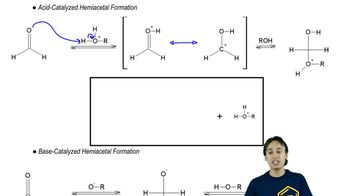
    A reaction where a nucleophile attacks an electrophilic carbon, leading to the formation of new bonds, central to hemiacetal formation.
  • Geminal Position

    A situation where two substituents are attached to the same carbon atom, as seen in acetals and hemiacetals.
  • Cyclic Hemiacetal

    A ring structure where a hemiacetal functional group is part of the ring, providing enhanced stability.
  • Ether

    An oxygen atom bonded to two carbon atoms, present as one of the groups in both hemiacetals and acetals.
  • Alcohol

    A functional group containing an -OH, acting as both a reactant and a substituent in hemiacetal and acetal formation.
  • Aldehyde

    A carbonyl-containing compound with at least one hydrogen attached to the carbonyl carbon, a common starting material for hemiacetals.
  • Base Catalysis

    A reaction pathway where a base generates a strong nucleophile, simplifying the formation of hemiacetals.
  • Acid Catalysis

    A mechanism where an acid increases the electrophilicity of the carbonyl, facilitating nucleophilic attack by alcohol.
  • Resonance Structure

    An alternative Lewis structure showing electron delocalization, used to clarify charge distribution during mechanisms.
  • Tetrahedral Intermediate

    A transient species formed when a nucleophile adds to a carbonyl, resulting in a central carbon bonded to four groups.