Skip to main content
Organic Chemistry
My Course
Learn
Exam Prep
AI Tutor
Study Guides
Textbook Solutions
Flashcards
Explore
Try the app
My Course
Learn
Exam Prep
AI Tutor
Study Guides
Textbook Solutions
Flashcards
Explore
Try the app
Back
Hammond Postulate definitions
You can tap to flip the card.
Hammond Postulate
You can tap to flip the card.
👆
Hammond Postulate
A principle stating that a transition state's structure resembles the highest energy species on a free energy diagram.
Track progress
Control buttons has been changed to "navigation" mode.
1/12
Related flashcards
Related practice
Recommended videos
Hammond Postulate quiz #1
Hammond Postulate
9 Terms
Hammond Postulate
6. Thermodynamics and Kinetics
6 problems
Topic
Nicole
Carbocation Stability
6. Thermodynamics and Kinetics
6 problems
Topic
Johnny
6. Thermodynamics and Kinetics - Part 1 of 2
4 topics
11 problems
Chapter
Ernest
6. Thermodynamics and Kinetics - Part 2 of 2
4 topics
10 problems
Chapter
Johnny
Guided course
01:30
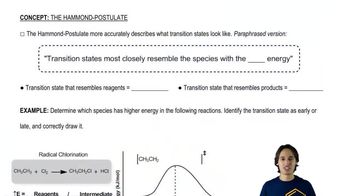
Defining the Hammond Postulate.
6
views
Guided course
02:58
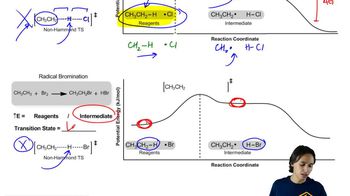
Bromination explains the Hammond Postulate.
8
views
Guided course
05:23
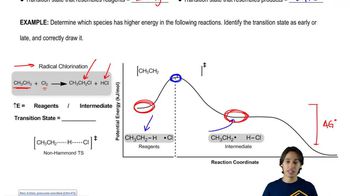
Chlorination explains the Hammond Postulate.
5
views
Terms in this set (12)
Hide definitions
Hammond Postulate
A principle stating that a transition state's structure resembles the highest energy species on a free energy diagram.
Transition State
A point of maximum energy connecting higher and lower energy species during a chemical reaction.
Free Energy Diagram
A graphical representation showing energy changes of reactants, products, and transition states during a reaction.
Early Transition State
A high-energy configuration that closely resembles the reactants in structure and energy.
Late Transition State
A high-energy configuration that closely resembles the products in structure and energy.
Reactants
The starting chemical species in a reaction, often compared to transition states for structural similarity.
Products
The resulting chemical species after a reaction, sometimes closely mirrored by the transition state.
Energy Barrier
The energy difference between reactants and the transition state, representing the minimum energy needed for reaction.
Highest Energy Point
The peak on a free energy diagram, corresponding to the transition state of a reaction.
Species
Any distinct chemical entity, such as reactants, products, or intermediates, involved in a reaction.
Reagents
Substances present at the start of a reaction, whose structure may be reflected in an early transition state.
Structural Resemblance
The degree to which a transition state mimics the geometry or features of reactants or products.
 BackBack


 01:30
01:30