Back

Halogenation quiz

Control buttons has been changed to "navigation" mode.
1/15
  • What is halogenation in the context of organic chemistry?

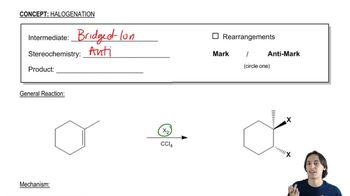
    Halogenation is the addition of a diatomic halogen to a double bond, resulting in anti vicinal dihalides.
  • What type of intermediate is formed during the halogenation of alkenes?

    A three-membered halonium ion bridge is formed as the intermediate.
  • What does the term 'vicinal' mean in the context of dihalides?

    'Vicinal' means that the two halogen atoms are attached to adjacent carbon atoms (1,2-relationship).
  • Does halogenation of alkenes involve carbocation rearrangements?

    No, there are no carbocation rearrangements because a carbocation is not formed in this mechanism.
  • Is Markovnikov's rule relevant in halogenation reactions?

    No, Markovnikov's rule does not apply because two identical halogen atoms are added.
  • What is the stereochemistry of the product in halogenation reactions?

    The products are anti, meaning the two halogen atoms add to opposite sides of the double bond.
  • What is the role of solvents like CCl4 or CH2Cl2 in halogenation?

    These solvents are inert and do not participate in the reaction; they simply help the reaction proceed.
  • How does the double bond interact with the diatomic halogen during halogenation?

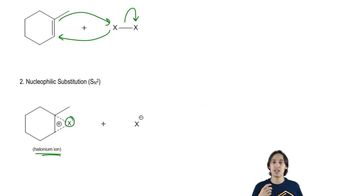
    The double bond attacks the partially positive halogen, initiating the reaction and forming the halonium ion.
  • What is a halonium ion?

    A halonium ion is a three-membered ring intermediate containing a halogen atom and two carbons.
  • How does the halide ion (X-) attack the halonium ion?

    The halide ion attacks from the backside (SN2 mechanism), opening the three-membered ring.
  • Why are anti products formed in halogenation?

    Anti products are formed because the backside attack opens the strained three-membered ring, placing the halogens on opposite sides.
  • What determines which carbon the halide ion attacks in the halonium ion?

    The halide ion attacks the more substituted carbon, which stabilizes positive charge better.
  • What is the outcome regarding enantiomers in halogenation of alkenes?

    Two enantiomers are produced in equal amounts, resulting in a racemic mixture.
  • What happens to the three-membered ring during the halogenation mechanism?

    The ring is broken open by the backside attack of the halide ion, leading to anti addition.
  • What is the general result of halogenation of a simple alkene?

    The general result is the formation of a vicinal dihalide with anti stereochemistry.