Back

Haloform Reaction definitions

Control buttons has been changed to "navigation" mode.
1/15
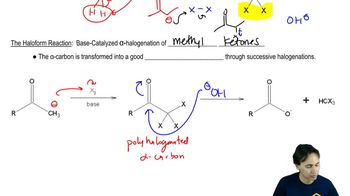
  • Haloform Reaction

    A base-catalyzed process converting methylketones into carboxylic acids and trihalomethyl compounds via alpha halogenation.
  • Methylketone

    A compound featuring a carbonyl group bonded to a methyl group, serving as the key substrate in this transformation.
  • Alpha Halogenation

    The introduction of halogen atoms to the carbon adjacent to a carbonyl, crucial for forming a good leaving group.
  • Enolate

    A resonance-stabilized intermediate formed by deprotonation at the alpha position of a carbonyl compound under basic conditions.
  • Polyhalogenated Alpha Carbon

    A carbon atom next to a carbonyl bearing three halogen atoms, greatly enhancing its leaving group ability.
  • Leaving Group

    An atom or group that departs with a pair of electrons during a reaction, facilitating product formation.
  • Tetrahedral Intermediate

    A transient species with four substituents around a central atom, formed during nucleophilic attack on a carbonyl.
  • Carboxylic Acid

    A product of the reaction, characterized by a carbonyl and hydroxyl group on the same carbon.
  • Carboxylate

    The deprotonated, anionic form of a carboxylic acid, generated after reaction with a strong base.
  • Haloform

    A molecule with a methyl group where all hydrogens are replaced by halogens, such as chloroform or iodoform.
  • Chloroform

    A trihalomethyl compound (CHCl3) produced when chlorine is the halogen in the reaction.
  • Iodoform

    A yellow, crystalline trihalomethyl compound (CHI3) formed with iodine, used as a diagnostic test for methylketones.
  • Base Catalysis

    The acceleration of a reaction by a base, which abstracts a proton to generate reactive intermediates.
  • Precipitate

    A solid formed from solution, such as yellow iodoform, indicating the presence of a methylketone.
  • CX3 Negative Ion

    A trihalomethyl anion generated during the reaction, capable of deprotonating carboxylic acids.