Skip to main content
Organic Chemistry
My Course
Learn
Exam Prep
AI Tutor
Study Guides
Textbook Solutions
Flashcards
Explore
Try the app
My Course
Learn
Exam Prep
AI Tutor
Study Guides
Textbook Solutions
Flashcards
Explore
Try the app
Back
Gibbs Free Energy definitions
You can tap to flip the card.
Gibbs Free Energy
You can tap to flip the card.
👆
Gibbs Free Energy
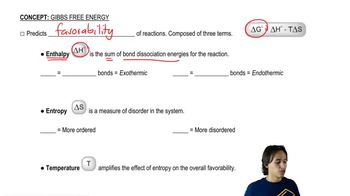
Predicts reaction favorability by combining enthalpy, entropy, and temperature; negative values indicate spontaneous processes.
Track progress
Control buttons has been changed to "navigation" mode.
1/15
Related flashcards
Related practice
Recommended videos
Gibbs Free Energy quiz
Gibbs Free Energy
15 Terms
Gibbs Free Energy
6. Thermodynamics and Kinetics
7 problems
Topic
Johnny
Enthalpy
6. Thermodynamics and Kinetics
7 problems
Topic
Johnny
6. Thermodynamics and Kinetics - Part 1 of 2
4 topics
11 problems
Chapter
Ernest
6. Thermodynamics and Kinetics - Part 2 of 2
4 topics
10 problems
Chapter
Johnny
06:55
Intermediates vs. Transition States
7
views
05:02
Breaking down the different terms of the Gibbs Free Energy equation.
12
views
Terms in this set (15)
Hide definitions
Gibbs Free Energy
Predicts reaction favorability by combining enthalpy, entropy, and temperature; negative values indicate spontaneous processes.
Enthalpy
Represents the sum of bond association energies; negative values indicate bond formation, positive values indicate bond breaking.
Entropy
Measures system disorder; positive values favor increased randomness, while negative values indicate increased order.
Exothermic Reaction
Process where energy is released due to bond formation, resulting in a negative enthalpy change.
Endothermic Reaction
Process where energy is absorbed due to bond breaking, resulting in a positive enthalpy change.
Temperature
Amplifies the effect of entropy on reaction favorability; higher values make disorder more influential.
Transition State
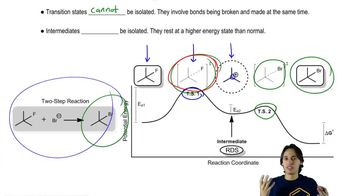
High-energy, transient configuration at the peak of a reaction coordinate; cannot be isolated in a test tube.
Intermediate
Higher-energy species between reactants and products that can be isolated and observed.
Free Energy Diagram
Graphical representation showing energy changes during a reaction, highlighting transition states and intermediates.
Activation Energy
Minimum energy required to reach a transition state from reactants; determines the reaction rate.
Rate-Determining Step
Step with the highest activation energy in a multi-step reaction, controlling the overall reaction speed.
Spontaneity
Describes whether a reaction proceeds without external input, closely linked to negative Gibbs free energy.
Exergonic Reaction
Process with a negative Gibbs free energy, indicating a thermodynamically favored reaction.
Endergonic Reaction
Process with a positive Gibbs free energy, indicating a non-favored reaction under standard conditions.
Bond Association Energy
Energy required to break or form chemical bonds, contributing to the overall enthalpy change.
 BackBack

 06:55
06:55