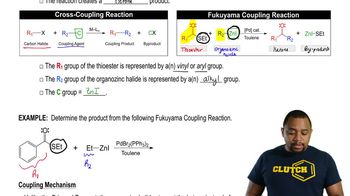
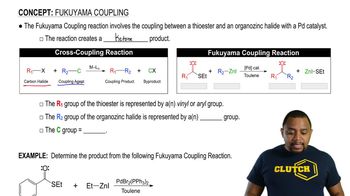
What is the main product of the Fukuyama coupling reaction?
The main product is a ketone formed by coupling a thioester with an organozinc halide using a palladium catalyst.
Which two reactants are coupled in the Fukuyama coupling reaction?
A thioester and an organozinc halide are coupled in the presence of a palladium catalyst.
What is the role of palladium in the Fukuyama coupling reaction?
Palladium acts as a catalyst, facilitating the reaction through oxidative addition, transmetalation, and reductive elimination steps.
What is the solvent typically used in the Fukuyama coupling reaction?
Toluene is typically used as the solvent in this reaction.
What is the key advantage of the Fukuyama coupling over Grignard reactions with esters?
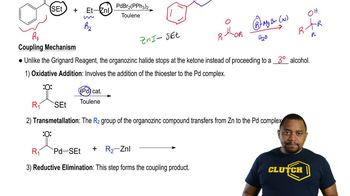
The Fukuyama coupling stops at the ketone stage and does not proceed to form a tertiary alcohol, unlike Grignard reactions.
What are the three main mechanistic steps in the Fukuyama coupling reaction?
The steps are oxidative addition, transmetalation, and reductive elimination.
During oxidative addition in the Fukuyama coupling, what attaches to the palladium catalyst?
The thioester attaches to the palladium catalyst, forming a complex with the R1 acyl group.
What happens during the transmetalation step of the Fukuyama coupling?
The R2 group from the organozinc halide transfers to the palladium complex, displacing the thioester group.
What is the byproduct formed during the transmetalation step?
The byproduct is a zinc iodide complex attached to the sulfur ethyl group (SET) from the thioester.
What occurs during the reductive elimination step in the Fukuyama coupling?
The R1 acyl group and R2 group combine to form the ketone, and the palladium catalyst is regenerated.
What types of groups are typically used for R1 and R2 in the Fukuyama coupling?
R1 is usually a vinyl or aryl group, while R2 is typically an alkyl group.
Why does the Fukuyama coupling not produce a tertiary alcohol like the Grignard reaction?
Because the organozinc halide is less reactive and the reaction conditions prevent further addition beyond the ketone stage.
What drives the catalytic cycle in the Fukuyama coupling reaction?
The need for the palladium catalyst to achieve the 18 or 16 electron rule drives the cycle, propelling it to re-enter the catalytic process.
What is lost from the thioester and organozinc halide during the Fukuyama coupling?
The sulfur ethyl portion (SET) from the thioester and the zinc iodide portion from the organozinc halide are lost as byproducts.
What is a thioester, and how does it differ from a regular ester in this context?
A thioester is an analog of an ester where the oxygen is replaced by sulfur; in this reaction, it allows selective ketone formation without overreaction.