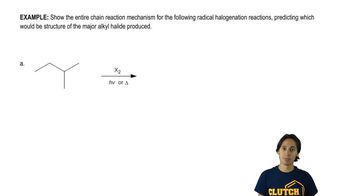
Why are alkanes not considered functional groups in organic chemistry?
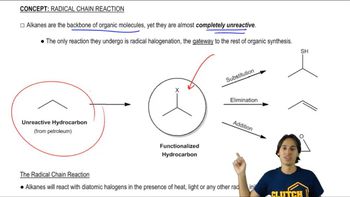
Alkanes are not considered functional groups because they are very stable and unreactive, meaning they do not participate in most chemical reactions.
What is the main reaction that allows alkanes to become functionalized?
Alkanes can undergo free radical halogenation, which allows them to react with halogens and become functionalized as alkyl halides.
What are the three steps of the radical halogenation mechanism?
The three steps are initiation, propagation, and termination.
What happens during the initiation step of radical halogenation?
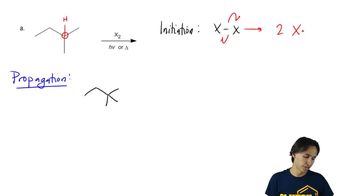
During initiation, radicals are generated, typically by splitting a diatomic halogen (X2) using heat or light.
What is the role of the propagation step in radical halogenation?
In propagation, radicals react with alkanes to form alkyl halides and regenerate the original radical, continuing the chain reaction.
How is the termination step defined in radical halogenation?
Termination occurs when two radicals collide and combine, extinguishing each other and ending the chain reaction.
Why is the formation of larger hydrocarbons like ethane a minor product in radical halogenation?
The formation of larger hydrocarbons is rare because the concentration of alkyl radicals is much lower than that of halogen radicals, especially when excess halogen is used.
What is the main product of free radical halogenation of alkanes?
The main product is an alkyl halide, which is important for further organic synthesis.
Why is the radical chain reaction described as a 'game of hot potato'?
Because the high-energy radical intermediate is continuously passed along from one molecule to another until the reaction is complete.
What is the significance of forming an alkyl halide from an alkane?
Forming an alkyl halide introduces a functional group, enabling the molecule to undergo further reactions like substitution or elimination.
What is the simplest alkane used to illustrate the radical halogenation mechanism?
Methane (CH4) is often used as the simplest example.
What happens when two halogen radicals (X• + X•) collide during termination?
They recombine to form a diatomic halogen molecule (X2), but this product is not significant because it can be split again.
How can you minimize the formation of larger hydrocarbons during radical halogenation?
By using an excess of halogen relative to alkane, you reduce the chance of two alkyl radicals colliding.
Why is it important to write all three steps (initiation, propagation, termination) when drawing the mechanism?
Because professors often require all three steps to be shown for full credit, even though only one major product is formed.
What is the functional group called when a carbon is bonded to a halogen after halogenation?
 Back
Back

 02:05
02:05