Back

Ether Cleavage quiz

Control buttons has been changed to "navigation" mode.
1/15
  • What type of acids are required to cleave ethers?

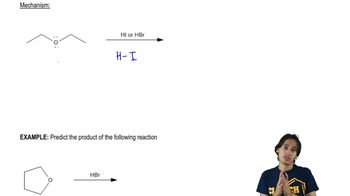
    Ethers are cleaved only by strong acids such as HI or HBr; weaker acids like HCl or HF are not effective.
  • What is the first step in the mechanism of ether cleavage by HI?

    The ether oxygen is protonated by HI, giving the oxygen a formal positive charge.
  • What role does the halide ion play in ether cleavage?

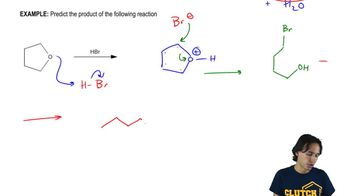
    The halide ion acts as a nucleophile, performing a backside attack on the carbon chain and displacing the protonated oxygen as a leaving group.
  • What are the products of the initial cleavage of an ether with HI?

    The initial cleavage yields an alkyl iodide and an alcohol.
  • What happens to the alcohol produced in the first step of ether cleavage?

    The alcohol can be protonated by another equivalent of HI, converting it into a good leaving group.
  • What mechanism is used to convert the protonated alcohol to an alkyl halide?

    The conversion occurs via an SN2 mechanism, where the halide ion attacks and displaces water.
  • How many equivalents of alkyl halide are produced from the cleavage of a simple ether?

    Two equivalents of alkyl halide are produced, one from each side of the ether.
  • Why are ethers considered highly stable and unreactive?

    Ethers have strong bonds and are almost as unreactive as alkanes, making heterolytic bond cleavage difficult without strong acids.
  • Can HCl or HF cleave ethers under normal conditions?

    No, only HI or HBr are strong enough to cleave ethers; HCl and HF are not effective.
  • What is the significance of nucleophilic substitution in ether cleavage?

    Nucleophilic substitution is key to the mechanism, as the halide ion attacks the carbon, leading to the formation of alkyl halides.
  • What is the final product when a cyclic ether reacts with HBr?

    The cyclic ether is cleaved to produce two equivalents of alkyl bromide, one from each side of the ring.
  • What distinguishes a cyclic ether from an epoxide?

    A cyclic ether can have more than three members in its ring, while an epoxide is specifically a three-membered ring.
  • What is the leaving group in the SN2 step of alcohol conversion during ether cleavage?

    Water acts as the leaving group when the protonated alcohol is attacked by the halide ion.
  • Why does the ether cleavage reaction occur twice?

    The reaction occurs twice because both sides of the ether can be cleaved, producing two alkyl halides.
  • What is the overall importance of understanding ether cleavage in organic chemistry?

    Ether cleavage demonstrates the principles of nucleophilic substitution, alkyl halide formation, and acid derivatives, which are fundamental in organic synthesis.