Back

Epoxidation definitions

Control buttons has been changed to "navigation" mode.
1/15
  • Epoxide

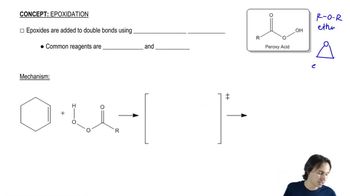
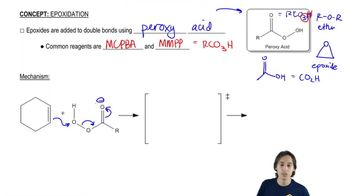
    A three-membered cyclic ether with two carbon atoms and one oxygen atom forming a strained ring.
  • Peroxy Acid

    A compound similar to a carboxylic acid but with an extra oxygen atom, commonly used to introduce oxygen into alkenes.
  • MCPBA

    A widely used peroxy acid reagent for converting alkenes into epoxides in organic synthesis.
  • MMPP

    A peroxy acid reagent, less common than MCPBA, also effective for epoxidation of alkenes.
  • Carboxylic Acid

    An organic acid with a carbonyl and hydroxyl group bonded to the same carbon, precursor to peroxy acids.
  • Transition State

    A high-energy, fleeting arrangement of atoms with partial bonds during the conversion of reactants to products.
  • Halohydrin

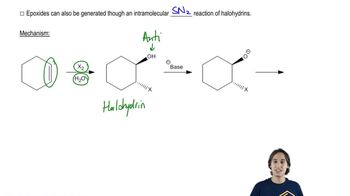
    A molecule containing both a halogen and a hydroxyl group on adjacent carbons, formed from alkene addition.
  • SN2 Reaction

    A one-step nucleophilic substitution mechanism involving a backside attack and simultaneous bond formation and breaking.
  • Nucleophile

    An electron-rich species that donates a pair of electrons to form a new chemical bond.
  • Leaving Group

    An atom or group that departs with a pair of electrons during a substitution or elimination reaction.
  • Diatomic Halogen

    A molecule consisting of two identical halogen atoms, such as Br2 or Cl2, used in addition reactions.
  • Base

    A substance that removes a proton from another molecule, often generating a nucleophile in organic reactions.
  • Alcohol

    A functional group featuring a hydroxyl group attached to a saturated carbon atom, often a precursor in halohydrin formation.
  • Partial Bond

    A bond that is not fully formed or broken, typically present in the transition state of a reaction.
  • Backside Attack

    A feature of SN2 reactions where the nucleophile approaches the substrate from the side opposite the leaving group.