Back

Epimerization definitions

Control buttons has been changed to "navigation" mode.
1/15
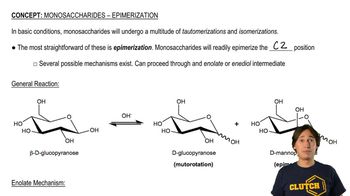
  • Epimerization

    Conversion of a molecule into its epimer by altering the configuration at a single chiral center, often at C2 in sugars.
  • Monosaccharide

    Simple sugar molecule that can undergo various isomerizations and tautomerizations under basic conditions.
  • Base Catalysis

    Acceleration of a chemical reaction by a base, often leading to complex mixtures in sugar chemistry.
  • C2 Position

    Second carbon in a sugar ring, commonly involved in stereochemical changes during epimerization.
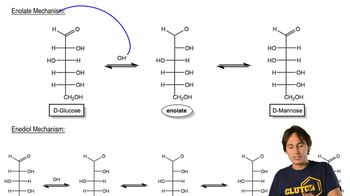
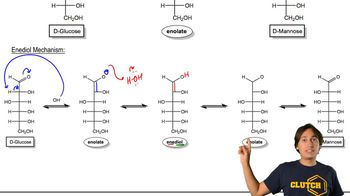
  • Enolate Mechanism

    Pathway involving deprotonation at the alpha carbon next to a carbonyl, forming an enolate intermediate.
  • Enediol Mechanism

    Route where deprotonation forms a double bond with two hydroxyl groups, creating an enediol intermediate.
  • Alpha Carbon

    Carbon atom adjacent to a carbonyl group, notable for its increased acidity and reactivity in base.
  • Anomer

    Isomer differing at the C1 position in sugars, resulting from mutarotation, not to be confused with epimers at C2.
  • Mutarotation

    Equilibration between different anomers at the C1 position, leading to a mixture of alpha and beta forms.
  • Enolate

    Resonance-stabilized intermediate with a negative charge on the alpha carbon, formed during base-catalyzed reactions.
  • Enediol

    Intermediate featuring a double bond flanked by two hydroxyl groups, central to one pathway of epimerization.
  • Stereochemistry

    Spatial arrangement of atoms in molecules, crucial for understanding changes during epimerization.
  • Racemization

    Loss of stereochemical information at a chiral center, resulting in a mixture of configurations.
  • D-Glucopyranose

    Six-membered ring form of glucose, often used as a model for studying epimerization.
  • D-Mannopyranose

    Monosaccharide formed from D-glucopyranose by inversion at the C2 hydroxyl group.