Back

Enolate Alkylation and Acylation quiz

Control buttons has been changed to "navigation" mode.
1/15
  • What is the key step in enolate alkylation and acylation reactions?

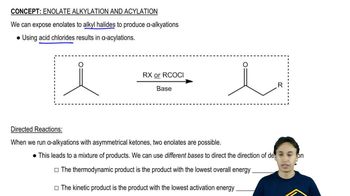
    The key step is the formation of an enolate, which then attacks an alkyl halide or acid chloride to form an alpha-alkylated or acylated product.
  • What type of product is formed when an enolate reacts with an alkyl halide?

    An alpha-alkylated carbon is formed as the product.
  • What type of product is formed when an enolate reacts with an acid chloride?

    A beta-dicarbonyl compound with an acyl group is formed.
  • Why are directed reactions necessary for asymmetrical ketones in enolate chemistry?

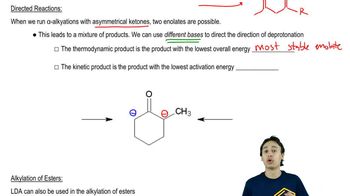
    Directed reactions are necessary because asymmetrical ketones can form more than one enolate, leading to different products.
  • How can you control which enolate forms from an asymmetrical ketone?

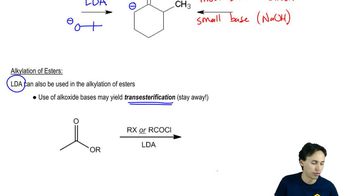
    You can control enolate formation by choosing the appropriate base: bulky bases favor kinetic enolates, while small bases favor thermodynamic enolates.
  • What characterizes the thermodynamic enolate product?

    The thermodynamic product is the more stable enolate, typically with the most substituted alpha carbon.
  • What characterizes the kinetic enolate product?

    The kinetic product is the less substituted enolate, which is easier and faster to form due to less steric hindrance.
  • Which base is commonly used to favor the kinetic enolate product?

    LDA (lithium diisopropylamide) is commonly used to favor the kinetic enolate product.
  • Which base is commonly used to favor the thermodynamic enolate product?

    Small bases like NaOH are used to favor the thermodynamic enolate product.
  • Why is LDA considered a non-nucleophilic base?

    LDA is non-nucleophilic because its bulky structure prevents it from donating electrons to attack electrophilic carbons.
  • Why should LDA be used instead of hydroxide or alkoxide bases for enolate formation from esters?

    LDA should be used because hydroxide or alkoxide bases can cause hydrolysis or transesterification of esters, leading to unwanted side reactions.
  • What happens if you use hydroxide as a base with an ester?

    Using hydroxide with an ester leads to hydrolysis, forming a carboxylate instead of the desired enolate.
  • What is the result of using an alkoxide base with a different R group than the ester in enolate formation?

    This can cause transesterification, where the ester group is exchanged for the alkoxide's R group.
  • What is the role of the base in enolate alkylation and acylation reactions?

    The base deprotonates the alpha carbon to generate the enolate, which then acts as a nucleophile.
  • How do you determine which side of an asymmetrical ketone will be alkylated or acylated?

    The side that is alkylated or acylated depends on which enolate is formed, which is controlled by the choice of base (bulky for kinetic, small for thermodynamic).