Skip to main content
Organic Chemistry
My Course
Learn
Exam Prep
AI Tutor
Study Guides
Textbook Solutions
Flashcards
Explore
Try the app
My Course
Learn
Exam Prep
AI Tutor
Study Guides
Textbook Solutions
Flashcards
Explore
Try the app
Back
Energy Diagram quiz
You can tap to flip the card.
What does a free energy diagram summarize in a chemical reaction?
You can tap to flip the card.
👆
What does a free energy diagram summarize in a chemical reaction?
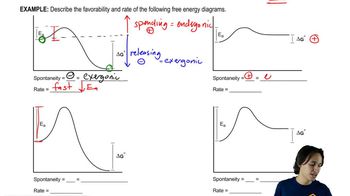
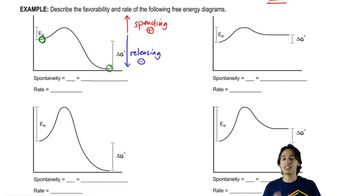
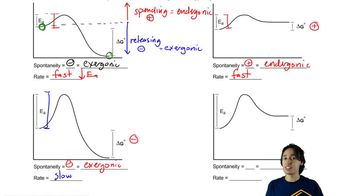
It summarizes the thermodynamics (spontaneity) and kinetics (rate) of a reaction.
Track progress
Control buttons has been changed to "navigation" mode.
1/15
Related flashcards
Related practice
Recommended videos
Energy Diagram definitions
Energy Diagram
15 Terms
Energy Diagram
6. Thermodynamics and Kinetics
7 problems
Topic
Johnny
Gibbs Free Energy
6. Thermodynamics and Kinetics
7 problems
Topic
Johnny
6. Thermodynamics and Kinetics - Part 1 of 2
4 topics
11 problems
Chapter
Ernest
6. Thermodynamics and Kinetics - Part 2 of 2
4 topics
10 problems
Chapter
Johnny
01:14
Favorability and rate of Free Energy Diagrams
10
views
00:34
Favorability and rate of Free Energy Diagrams
9
views
02:18
Favorability and rate of Free Energy Diagrams
9
views
Terms in this set (15)
Hide definitions
What does a free energy diagram summarize in a chemical reaction?
It summarizes the thermodynamics (spontaneity) and kinetics (rate) of a reaction.
What do atoms achieve by forming chemical bonds?
Atoms save energy by sharing electrons, lowering their energy state.
What does the X-axis of a free energy diagram represent?
The X-axis represents the reaction coordinate, showing the progression of the reaction.
What does the Y-axis of a free energy diagram typically represent?
The Y-axis represents heat (enthalpy) or spontaneity (Delta G).
What is the optimal distance between hydrogen atoms for maximum energy saving?
The optimal distance is 1.33 Angstroms, where the energy is minimized.
What is Gibbs free energy equation used to describe?
It describes thermodynamics and spontaneity: Delta G = Delta H - T*Delta S.
What does a negative Delta G indicate about a reaction?
A negative Delta G means the reaction is spontaneous and thermodynamically favorable.
What does the activation energy represent in a free energy diagram?
Activation energy is the energy difference between the starting point and the highest point in the diagram.
How is the rate of a reaction related to activation energy?
The rate depends on the activation energy; higher activation energy means a slower reaction.
Can a reaction be spontaneous but still occur slowly?
Yes, some spontaneous reactions have high activation energies and occur very slowly.
What information can you qualitatively determine from a free energy diagram?
You can determine if a reaction is spontaneous and whether it happens quickly or slowly.
What happens to the energy level of atoms after they form a bond?
Their energy level decreases, indicating energy is saved by bonding.
What is the significance of the highest point on a free energy diagram?
It represents the transition state and the activation energy required for the reaction.
What does the difference in energy between the beginning and end of a reaction represent?
It represents the change in Gibbs free energy (Delta G) and indicates spontaneity.
Why is it important to analyze free energy diagrams qualitatively at this stage?
It helps understand spontaneity and reaction rate without needing to perform calculations.
 BackBack

 01:14
01:14