Organic Chemistry
My Course
Learn
Exam Prep
AI Tutor
Study Guides
Textbook Solutions
Flashcards
Explore
Try the app
My Course
Learn
Exam Prep
AI Tutor
Study Guides
Textbook Solutions
Flashcards
Explore
Try the app
Back
Eglinton Reaction quiz
You can tap to flip the card.
What type of alkynes are used in the Eglinton reaction?
You can tap to flip the card.
👆
What type of alkynes are used in the Eglinton reaction?
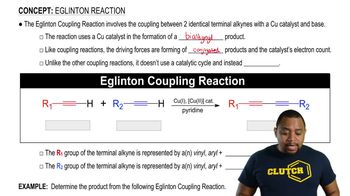
Two identical terminal alkynes are used in the Eglinton reaction.
Track progress
Control buttons has been changed to "navigation" mode.
1/15
Related flashcards
Related practice
Recommended videos
Eglinton Reaction definitions
Eglinton Reaction
14 Terms
27. Transition Metals
6 topics
14 problems
Chapter
Johnny
Guided course
04:16
Eglinton Reaction
6
views
Guided course
02:49
Eglinton Reaction
6
views
Guided course
02:05
Eglinton Reaction Example 1
5
views
Terms in this set (15)
Hide definitions
What type of alkynes are used in the Eglinton reaction?
Two identical terminal alkynes are used in the Eglinton reaction.
What catalyst is required for the Eglinton reaction?
A copper catalyst is required for the Eglinton reaction.
What is the role of pyridine in the Eglinton reaction?
Pyridine acts as a base to deprotonate the terminal alkyne.
What is the main product formed in the Eglinton reaction?
A conjugated bi-alkynyl (bialkaneal) product is formed.
How many basic steps are there in the Eglinton reaction mechanism?
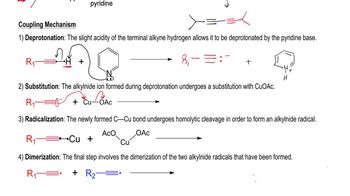
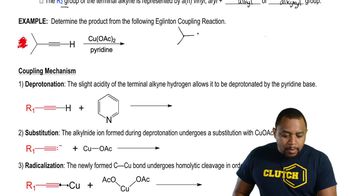
There are four basic steps: deprotonation, substitution, radicalization, and dimerization.
What happens during the deprotonation step of the Eglinton reaction?
The terminal alkyne hydrogen is removed by pyridine, forming an alkynide ion.
What is formed when the alkynide ion reacts with copper(I) acetate?
A copper-alkynide complex is formed.
What type of bond cleavage occurs during the radicalization step?
Homolytic cleavage of the copper-alkynide bond occurs, forming alkynide radicals.
What is the final step in the Eglinton reaction mechanism?
Dimerization, where two alkynide radicals combine to form the final product.
Why is it important to use identical alkynes in the Eglinton reaction?
Using identical alkynes avoids the formation of a mixture of products.
What is the driving force behind the Eglinton reaction?
The formation of a conjugated system, which increases stability, drives the reaction.
Does the Eglinton reaction use a catalytic cycle?
No, it proceeds through radical intermediates instead of a catalytic cycle.
What type of groups can the R groups on the terminal alkynes be?
The R groups can be vinyl, aryl, alkyl, or another alkyl group.
What is the role of copper in the Eglinton reaction?
Copper acts as a catalyst and forms a complex with the alkynide ion.
What is dimerization in the context of the Eglinton reaction?
Dimerization is when two alkynide radicals join together to form a stable conjugated product.