Skip to main content
Organic Chemistry
My Course
Learn
Exam Prep
AI Tutor
Study Guides
Textbook Solutions
Flashcards
Explore
Try the app
My Course
Learn
Exam Prep
AI Tutor
Study Guides
Textbook Solutions
Flashcards
Explore
Try the app
Back
Double Elimination definitions
You can tap to flip the card.
Double Dehydrohalogenation
You can tap to flip the card.
👆
Double Dehydrohalogenation
A process where two equivalents of base react with a dihalide, resulting in the formation of a triple bond.
Track progress
Control buttons has been changed to "navigation" mode.
1/13
Related flashcards
Related practice
Recommended videos
Double Elimination quiz #1
Double Dehydrohalogenation (Alkyne Synthesis)
10 Terms
Double Elimination
9. Alkenes and Alkynes
2 problems
Topic
Johnny
Acetylide
9. Alkenes and Alkynes
7 problems
Topic
Johnny
9. Alkenes and Alkynes - Part 1 of 2
5 topics
11 problems
Chapter
Ernest
9. Alkenes and Alkynes - Part 2 of 2
5 topics
11 problems
Chapter
Johnny
02:20
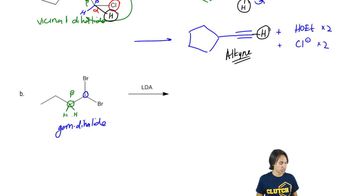
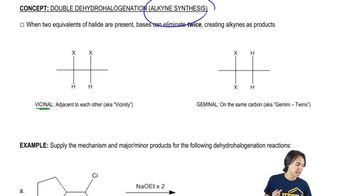
General features of double dehydrohalogenation.
5
views
02:26
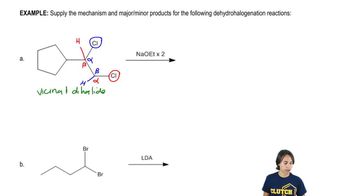
Supply the mechanism and product for the following reaction.
5
views
04:03
The double dehydrohalogenation mechanism.
5
views
Terms in this set (13)
Hide definitions
Double Dehydrohalogenation
A process where two equivalents of base react with a dihalide, resulting in the formation of a triple bond.
Alkyne
A hydrocarbon featuring a carbon-carbon triple bond, often synthesized via double elimination reactions.
Dihalide
A molecule containing two halogen atoms, which can be positioned on adjacent or the same carbon atoms.
Vicinal Dihalide
A compound with two halogens attached to neighboring carbons, described as having a 1,2 relationship.
Geminal Dihalide
A compound with two halogens bonded to the same carbon, described as having a 1,1 relationship.
Base
A substance that abstracts protons, facilitating the removal of halides during elimination to form multiple bonds.
Triple Bond
A bond involving three shared pairs of electrons between two carbons, characteristic of alkynes.
Substituent
An atom or group attached to a carbon chain, whose position is described by terms like vicinal or geminal.
Elimination
A reaction type where atoms or groups are removed from a molecule, often forming multiple bonds.
Halogen
A group 17 element, such as chlorine or bromine, commonly found as substituents in organic molecules.
Terminal
A descriptor for a group or bond located at the end of a carbon chain.
Internal
A descriptor for a group or bond located within the carbon chain, not at the end.
Position Word
A term used to specify the relative locations of substituents on a carbon skeleton, such as vicinal or geminal.
 BackBack

 02:20
02:20