Skip to main content
Organic Chemistry
My Course
Learn
Exam Prep
AI Tutor
Study Guides
Textbook Solutions
Flashcards
Explore
Try the app
My Course
Learn
Exam Prep
AI Tutor
Study Guides
Textbook Solutions
Flashcards
Explore
Try the app
Back
Directing Effects in Substituted Pyrroles, Furans, and Thiophenes definitions
You can tap to flip the card.
Heterocyclic Compound
You can tap to flip the card.
👆
Heterocyclic Compound
A five-membered aromatic ring containing at least one atom other than carbon, such as nitrogen, oxygen, or sulfur.
Track progress
Control buttons has been changed to "navigation" mode.
1/15
Related flashcards
Related practice
Recommended videos
Directing Effects in Substituted Pyrroles, Furans, and Thiophenes quiz
Directing Effects in Substituted Pyrroles, Furans, and Thiophenes
15 Terms
Directing Effects in Substituted Pyrroles, Furans, and Thiophenes
27. Heterocycles
5 problems
Topic
Addition Reactions of Furan
27. Heterocycles
5 problems
Topic
27. Heterocycles - Part 1 of 2
4 topics
12 problems
Chapter
27. Heterocycles - Part 2 of 2
4 topics
12 problems
Chapter
Guided course
3:26
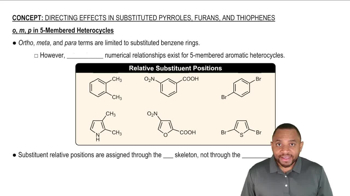
Directing Effects in Substituted Pyrroles, Furans, and Thiophenes Concept 2
6
views
Guided course
1:20
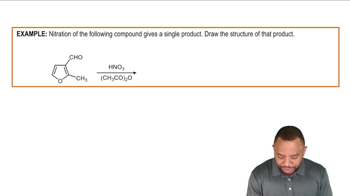
Directing Effects in Substituted Pyrroles, Furans, and Thiophenes Example 1
2
views
Guided course
2:02
Directing Effects in Substituted Pyrroles, Furans, and Thiophenes Concept 1
3
views
Terms in this set (15)
Hide definitions
Heterocyclic Compound
A five-membered aromatic ring containing at least one atom other than carbon, such as nitrogen, oxygen, or sulfur.
Electrophilic Aromatic Substitution
A reaction where an electrophile replaces a hydrogen atom on an aromatic ring, often occurring under milder conditions in heterocycles.
Ortho Position
A location on a ring adjacent to a reference substituent, corresponding to the 1,2-relationship in five-membered heterocycles.
Meta Position
A location on a ring separated by one carbon from a reference substituent, corresponding to the 1,3-relationship in five-membered heterocycles.
Para Position
A location on a ring directly opposite a reference substituent, corresponding to the 1,4-relationship in five-membered heterocycles.
Ortho-Para Director
A substituent that increases the likelihood of incoming groups attaching to adjacent or opposite positions on the ring.
Meta Director
A substituent that increases the likelihood of incoming groups attaching to the position separated by one carbon from itself.
C2 Position
A site on a five-membered heterocycle adjacent to the heteroatom, favored for substitution due to increased reactivity.
Heteroatom
A non-carbon atom, such as nitrogen, oxygen, or sulfur, within a ring structure, influencing reactivity and substitution patterns.
Activating Group
A substituent that increases the reactivity of the aromatic ring toward electrophilic substitution, often dictating substitution sites.
Substituent
An atom or group attached to a ring, affecting both the reactivity and the preferred position for further substitution.
Bromination
A process where a bromine atom is introduced onto an aromatic ring, often occurring without a catalyst in heterocycles.
Nitration
A process where a nitro group is introduced onto an aromatic ring, typically under mild conditions in heterocycles.
Sulfonation
A process where a sulfonic acid group is introduced onto an aromatic ring, with position influenced by both substituents and heteroatoms.
Di-Substituted Ring
An aromatic ring bearing two substituents, where the most activating group determines the preferred site for further substitution.
 BackBack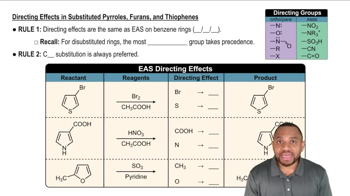
 3:26
3:26