Back

Diels-Alder Retrosynthesis quiz

Control buttons has been changed to "navigation" mode.
1/15
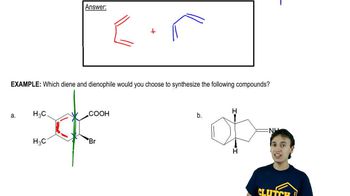
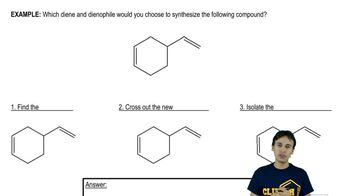
  • What is the main goal of Diels-Alder retrosynthesis?

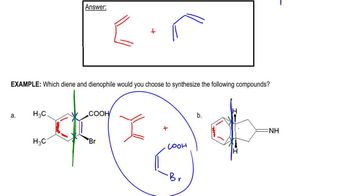
    To identify the original diene and dienophile that formed a given cyclization product.
  • Which key structural feature should you look for first in a Diels-Alder product during retrosynthesis?

    You should look for the new double bond formed between the second and third carbons.
  • How does the new double bond help you identify the original diene?

    The new double bond marks the 2 and 3 positions, allowing you to trace back to the 1 and 4 positions of the original diene.
  • What is the relationship between the diene and the dienophile in the Diels-Alder reaction?

    The diene forms two new bonds with the dienophile during the reaction.
  • What should you do after identifying the new bonds formed in the Diels-Alder product?

    You should cross out the new bonds to help isolate and identify the original dienophile.
  • Why is it important to recognize the landmark double bond in Diels-Alder retrosynthesis?

    It helps orient you within the molecule and guides you to reconstruct the original reactants.
  • What does crossing out the new bonds in the product reveal?

    It reveals the structure of the original dienophile that participated in the reaction.
  • What is a dimerization in the context of Diels-Alder reactions?

    Dimerization occurs when a molecule reacts with itself through the Diels-Alder mechanism.
  • How many new bonds are typically formed between the diene and dienophile in a Diels-Alder reaction?

    Two new bonds are formed between the diene and the dienophile.
  • What is the significance of the 1 and 4 positions in the diene for retrosynthesis?

    They indicate the ends of the conjugated system that react with the dienophile.
  • What is the first step in Diels-Alder retrosynthesis according to the tutorial?

    The first step is to find the new double bond in the product.
  • After crossing out the new bonds, what should you check for in the remaining structure?

    You should check that the remaining structure on the other side has a double bond, confirming it was the dienophile.
  • Why might Diels-Alder retrosynthesis seem challenging to students?

    Because it requires thinking backwards from the product to the reactants, which is less familiar than forward synthesis.
  • What practical technique does the instructor suggest for identifying the dienophile?

    Draw a line through the new bonds (x's) to separate the diene from the dienophile.
  • Why is practicing Diels-Alder retrosynthesis problems important?

    Practice helps students become more comfortable and skilled at identifying the original reactants from the product.