Back

Degrees of Unsaturation definitions

Control buttons has been changed to "navigation" mode.
1/14
  • Index of Hydrogen Deficiency

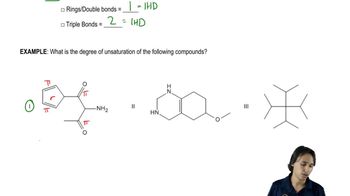
    A numerical value indicating the total number of rings and pi bonds present in a molecule.
  • Degree of Unsaturation

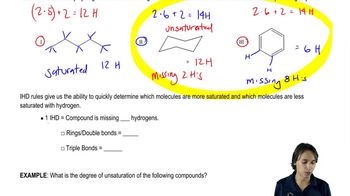
    A measure reflecting how many pairs of hydrogens a molecule is missing compared to a saturated structure.
  • Saturated Molecule

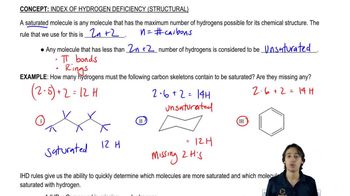
    A compound containing the maximum possible number of hydrogens, following the 2n+2 rule.
  • Unsaturated Molecule

    A compound with fewer hydrogens than the maximum, due to rings or pi bonds in its structure.
  • 2n+2 Rule

    A formula used to calculate the maximum number of hydrogens in a fully saturated hydrocarbon.
  • Pi Bond

    A type of covalent bond formed from the side-by-side overlap of p orbitals, present in double and triple bonds.
  • Ring

    A closed loop of atoms in a molecule, causing a reduction in the number of hydrogens compared to an open chain.
  • Double Bond

    A chemical connection between two atoms involving one sigma and one pi bond, contributing one IHD.
  • Triple Bond

    A chemical connection involving one sigma and two pi bonds, contributing two IHD.
  • Halogen

    An atom from group 17 that, when present in a molecule, is counted as equivalent to one hydrogen in IHD calculations.
  • Oxygen

    An atom that is ignored in IHD calculations, having no effect on the hydrogen count.
  • Nitrogen

    An atom that, when present, is counted as negative one hydrogen in IHD calculations.
  • Hydrogen Equivalent

    A concept where certain atoms are counted as hydrogens or subtracted from the hydrogen count in IHD calculations.
  • Molecular Formula

    A representation showing the number and type of atoms in a molecule, used for calculating IHD when structure is unknown.