Back

Decalin quiz

Control buttons has been changed to "navigation" mode.
1/15
  • What is a decalin molecule composed of?

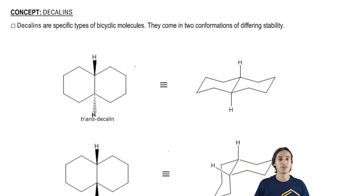
    A decalin molecule consists of two fused cyclohexane rings, forming a bicyclic structure.
  • How are trans-decalin and cis-decalin distinguished?

    They are distinguished by the orientation of hydrogens at the bridgehead atoms: trans-decalin has hydrogens on opposite sides, while cis-decalin has them on the same side.
  • Which form of decalin is more stable and why?

    Trans-decalin is more stable due to minimal steric and torsional strain between the rings.
  • What causes cis-decalin to be less stable than trans-decalin?

    Cis-decalin has increased steric interactions and torsional strain because the rings and bridgehead hydrogens are closer together.
  • What is a bridgehead atom in decalin?

    A bridgehead atom is the carbon where the two cyclohexane rings are fused together.
  • When drawing decalin in chair conformation, which form should be used for maximum stability?

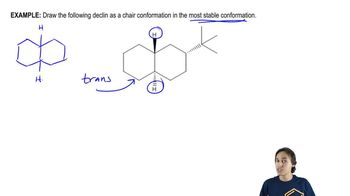
    Trans-decalin should be used because it represents the most stable conformation.
  • How do you draw a trans-decalin chair conformation?

    Draw two connected chair conformations with bridgehead hydrogens on opposite faces.
  • Why should substituents be placed in the equatorial position in decalin chair conformations?

    Placing substituents in the equatorial position minimizes steric strain and increases stability.
  • What is the effect of placing a tert-butyl group in the axial position on decalin?

    It increases steric strain, making the conformation less stable compared to the equatorial position.
  • How many carbons away from the bridgehead is a tert-butyl group if placed as described in the lesson?

    The tert-butyl group is placed two carbons away from the bridgehead atom.
  • What is the main structural difference between cis- and trans-decalin?

    The main difference is the orientation of the bridgehead hydrogens: same side for cis, opposite sides for trans.
  • What type of strain is minimized in trans-decalin?

    Trans-decalin minimizes both steric and torsional strain between the rings.
  • Why might professors test students on decalins despite them being a specialized topic?

    Some professors include decalins to assess students' understanding of chair conformations and stability.
  • What principle should guide the placement of substituents in decalin chair conformations?

    The largest substituent should be placed in the equatorial position for maximum stability.
  • What is the significance of being able to draw both cis and trans decalins?

    It demonstrates understanding of ring fusion, conformational stability, and the effects of substituent placement.