Back

Crossed Aldol Condensation quiz

Control buttons has been changed to "navigation" mode.
1/15
  • What is a crossed aldol condensation?

    A crossed aldol condensation is an aldol reaction between two different aldehydes or ketones, leading to a mixture of products.
  • Why do crossed aldol condensations often result in complex mixtures?

    Because both carbonyl compounds can form enolates and act as electrophiles, leading to multiple possible products.
  • How many different products can be formed when mixing two different aldehydes in an aldol condensation?

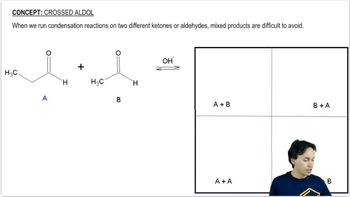
    Four products can be formed: AA, AB, BA, and BB, where the first letter represents the enolate source.
  • What does the Punnett square illustrate in the context of crossed aldol condensations?

    It shows all possible product combinations that can result from the reaction of two different aldehydes or ketones.
  • Why are AB and BA products not the same in a crossed aldol condensation?

    Because the enolate and electrophile are different in each case, leading to products with different structures or carbon arrangements.
  • What is a major synthetic challenge of crossed aldol reactions?

    The difficulty in controlling which product forms, resulting in a mixture that is hard to separate.
  • How can you minimize the number of products in a crossed aldol condensation?

    By using a non-enolizable aldehyde or ketone, which lacks alpha hydrogens and cannot form an enolate.
  • What is a non-enolizable carbonyl compound?

    It is a carbonyl compound that does not have any alpha hydrogens, so it cannot form an enolate.
  • Give two examples of non-enolizable carbonyl compounds.

    Formaldehyde and benzaldehyde are both non-enolizable because they lack alpha hydrogens.
  • Why does using a non-enolizable carbonyl simplify a crossed aldol reaction?

    Because only one enolate can form, ensuring that only one product is generated.
  • What role does a non-enolizable carbonyl play in a crossed aldol condensation?

    It acts only as the electrophile and cannot form an enolate, so it is always attacked by the enolate from the other compound.
  • How can you verify the structure of an aldol product?

    By counting the number of carbons from each starting material and ensuring the total matches the product.
  • What is the main reason synthetic chemists avoid crossed aldol condensations with two enolizable partners?

    Because it produces a complex mixture of products that are difficult to separate and purify.
  • What is meant by the term 'alpha proton' in the context of aldol reactions?

    An alpha proton is a hydrogen atom attached to the carbon adjacent to the carbonyl group, necessary for enolate formation.
  • What happens if both aldehydes in a crossed aldol condensation have alpha hydrogens?

    Both can form enolates, leading to four possible products and a complex mixture.