Back

Cope Rearrangement quiz

Control buttons has been changed to "navigation" mode.
1/15
  • What type of sigmatropic shift is the Cope rearrangement?

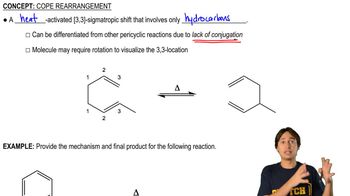
    The Cope rearrangement is a heat-activated 3,3 sigmatropic shift.
  • What types of atoms are involved in the Cope rearrangement?

    Only hydrocarbons are involved; there are no heteroatoms like oxygen.
  • Is the Cope rearrangement a concerted or stepwise reaction?

    It is a concerted reaction, meaning all bond changes occur simultaneously.
  • Is the Cope rearrangement reversible or irreversible?

    The Cope rearrangement is reversible.
  • How can you distinguish a Cope rearrangement from other pericyclic reactions?

    It involves only hydrocarbons and starts with an isolated, non-conjugated diene.
  • What is the significance of the '3,3' in the 3,3 sigmatropic shift?

    It refers to the positions where bonds are broken and formed: between the 1 and 3 positions on each end of the diene.
  • What is a key structural feature of the starting material in a Cope rearrangement?

    The starting material is an isolated diene, not a conjugated one.
  • Why might you need to rotate the molecular structure when analyzing a Cope rearrangement?

    Rotation helps visualize the 3,3 positions and the mechanism, especially if the structure is drawn linearly.
  • What happens to the bonds during the Cope rearrangement mechanism?

    A sigma bond between the 1 positions breaks, and a new sigma bond forms between the 3 positions.
  • Can the product of a Cope rearrangement ever be identical to the starting material?

    Yes, especially in simple cases with symmetrical or unsubstituted starting materials.
  • What type of reaction mechanism does the Cope rearrangement follow?

    It follows a pericyclic, non-ionic, concerted mechanism.
  • What should you check for to confirm a reaction is a Cope rearrangement?

    Check for an isolated diene with only hydrocarbons and no conjugation.
  • How do you name a Cope rearrangement based on the mechanism?

    You name it by the positions involved in bond breaking and making, such as a 3,3 Cope rearrangement.
  • What is the role of heat in the Cope rearrangement?

    Heat activates the rearrangement, allowing the concerted shift to occur.
  • Why is it important to redraw or rotate the molecule before analyzing the Cope rearrangement?

    Redrawing or rotating helps clearly identify the positions involved and understand the mechanism.