Back

Conjugation Chemistry definitions

Control buttons has been changed to "navigation" mode.
1/15
  • Conjugation

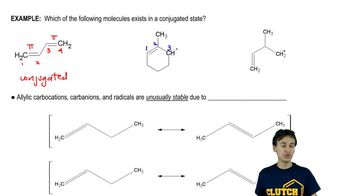
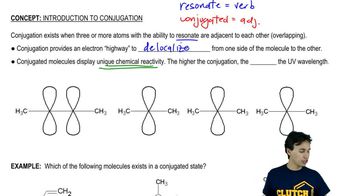
    A system where three or more adjacent atoms with overlapping orbitals allow electrons to delocalize, increasing molecular stability.
  • Resonance

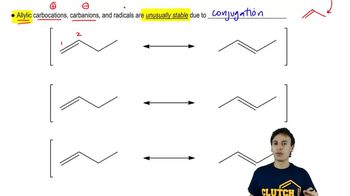
    A phenomenon where electrons are shared across multiple atoms, creating alternative structures that stabilize a molecule.
  • Delocalization

    The spreading of electrons across several atoms, reducing energy and enhancing molecular stability.
  • Pi Bond

    A type of bond formed by sideways overlap of orbitals, present in double and triple bonds, enabling electron movement.
  • Lone Pair

    A pair of non-bonding electrons on an atom, capable of participating in electron movement and resonance.
  • Radical

    A species with a single unpaired electron, able to participate in resonance and conjugation.
  • Cation

    A positively charged atom or group, often stabilized when adjacent to a double bond through conjugation.
  • Anion

    A negatively charged atom or group, often stabilized by resonance when adjacent to pi bonds.
  • Allylic Position

    A location directly next to a double bond, where atoms or charges experience enhanced stability via conjugation.
  • Reactive Intermediate

    A short-lived, high-energy species like carbocations, carbanions, or radicals, often stabilized by resonance.
  • Resonance Structure

    An alternative Lewis structure showing different electron arrangements, used to depict electron delocalization.
  • UV-Vis Spectrometer

    An instrument that measures absorption of ultraviolet and visible light, with higher conjugation shifting absorption to longer wavelengths.
  • Formal Charge

    A calculated value indicating the charge on an atom within a molecule, influencing resonance participation.
  • Double Bond

    A bond consisting of one sigma and one pi bond, enabling resonance when adjacent to suitable orbitals.
  • Triple Bond

    A bond containing one sigma and two pi bonds, allowing for resonance and conjugation in molecular structures.