Skip to main content
Organic Chemistry
My Course
Learn
Exam Prep
AI Tutor
Study Guides
Textbook Solutions
Flashcards
Explore
Try the app
My Course
Learn
Exam Prep
AI Tutor
Study Guides
Textbook Solutions
Flashcards
Explore
Try the app
Back
Cleavage of Phenyl Ethers definitions
You can tap to flip the card.
Phenyl Ether
You can tap to flip the card.
👆
Phenyl Ether
An ether where one side of the oxygen is bonded to a benzene ring, showing unique reactivity under acidic conditions.
Track progress
Control buttons has been changed to "navigation" mode.
1/13
Related flashcards
Related practice
Recommended videos
Cleavage of Phenyl Ethers quiz
Cleavage of Phenyl Ethers
15 Terms
Cleavage of Phenyl Ethers
20. Phenols
5 problems
Topic
Kolbe-Schmidt Reaction
20. Phenols
5 problems
Topic
25. Phenols
4 topics
12 problems
Chapter
Johnny
Guided course
1:45
Cleavage of Phenyl Ethers Concept 1
1
views
Guided course
1:57
Cleavage of Phenyl Ethers Example 1
3
views
Terms in this set (13)
Hide definitions
Phenyl Ether
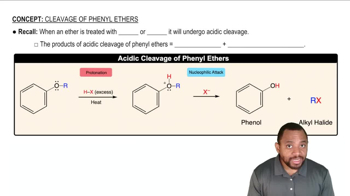
An ether where one side of the oxygen is bonded to a benzene ring, showing unique reactivity under acidic conditions.
Acidic Cleavage
A reaction where strong acids like HBr or HI break an ether bond, leading to specific products depending on the ether type.
Phenol
A stable aromatic alcohol formed as a product when phenyl ethers undergo cleavage, resistant to further reaction with strong acids.
Alkyl Halide
A compound produced from the non-benzene side of a phenyl ether after cleavage, containing a halogen atom.
Protonation
The process where an oxygen atom in an ether accepts a proton from a strong acid, increasing its reactivity.
Nucleophilic Attack
A step where a nucleophile targets the carbon atom of a protonated ether, leading to bond cleavage.
Benzene Ring
A stable aromatic structure in phenyl ethers that prevents further reaction after cleavage, ensuring phenol formation.
Ether Carbon
The carbon atom in an ether bond, specifically the one not attached to benzene, targeted during cleavage.
HBr
A strong acid commonly used to cleave ethers, especially effective in producing phenol and alkyl halide from phenyl ethers.
HI
A strong acid similar to HBr, used in the cleavage of phenyl ethers to yield phenol and an alkyl halide.
Excess Acid
A condition where more than one equivalent of strong acid is present, yet phenol remains unreactive in phenyl ether cleavage.
Oxygen Atom
The atom in phenyl ethers that becomes protonated, making the molecule susceptible to nucleophilic attack.
Bond Cleavage
The breaking of the ether bond during reaction with acid, resulting in the formation of phenol and an alkyl halide.
 BackBack
 1:45
1:45