Back

Claisen Rearrangement quiz

Control buttons has been changed to "navigation" mode.
1/15
  • What type of sigmatropic shift is the Claisen rearrangement?

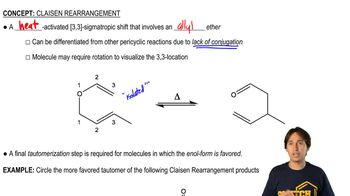
    The Claisen rearrangement is a 3,3-sigmatropic shift.
  • What functional group must be present in the reactant for a Claisen rearrangement to occur?

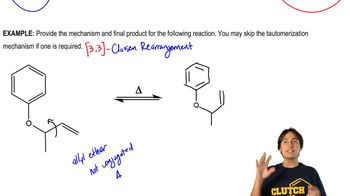
    An allyl ether must be present in the reactant for a Claisen rearrangement.
  • How is an allyl ether structurally defined?

    An allyl ether has an oxygen atom attached to a CH2 group, which is then connected to a double bond.
  • Is conjugation required for the Claisen rearrangement to take place?

    No, the Claisen rearrangement does not require any form of conjugation.
  • What bond is broken during the Claisen rearrangement mechanism?

    The bond between the '1' positions is broken during the Claisen rearrangement.
  • What bond is formed during the Claisen rearrangement mechanism?

    A new bond is formed between the '3' positions during the Claisen rearrangement.
  • What is the typical activation method for the Claisen rearrangement?

    The Claisen rearrangement is heat-activated.
  • What is the final product of a Claisen rearrangement often subject to?

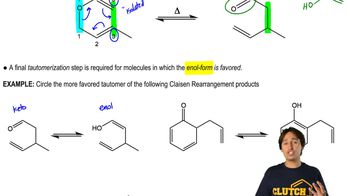
    The final product may require tautomerization between keto and enol forms.
  • Which tautomer is usually favored after a Claisen rearrangement: keto or enol?

    The keto form is usually favored after a Claisen rearrangement.
  • What must you do if the enol form is favored in the final product of a Claisen rearrangement?

    You must tautomerize to the enol form to get the correct answer.
  • Can the top part of the ether in a Claisen rearrangement vary?

    Yes, the top part can change and may be vinyl or phenyl, but the allyl ether part must always be present.
  • What type of reaction mechanism is the Claisen rearrangement?

    The Claisen rearrangement is a pericyclic and concerted mechanism.
  • What is the defining characteristic of a Claisen rearrangement reactant?

    The defining characteristic is the presence of an allyl ether group.
  • What should you do if the reactant is not drawn in a 'nice' orientation for the mechanism?

    You may need to rotate sigma bonds to position the molecule correctly before drawing the mechanism.
  • What happens if you fail to tautomerize to the favored enol form in a Claisen rearrangement product?

    You will get the question wrong because you picked the incorrect tautomer.