Organic Chemistry
My Course
Learn
Exam Prep
AI Tutor
Study Guides
Textbook Solutions
Flashcards
Explore
Try the app
My Course
Learn
Exam Prep
AI Tutor
Study Guides
Textbook Solutions
Flashcards
Explore
Try the app
Back
Cationic Polymerization quiz
You can tap to flip the card.
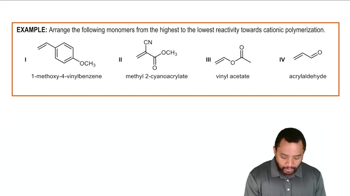
What type of alkenes typically undergo cationic polymerization?
You can tap to flip the card.
👆
What type of alkenes typically undergo cationic polymerization?
Alkenes with electron-donating groups typically undergo cationic polymerization.
Track progress
Control buttons has been changed to "navigation" mode.
1/15
Related flashcards
Recommended videos
Cationic Polymerization definitions
Cationic Polymerization
15 Terms
1:34
Cationic Polymerization Example 1
2
views
1:12
Cationic Polymerization Concept 4
1
views
0:52
Cationic Polymerization Concept 3
1
views
Terms in this set (15)
Hide definitions
What type of alkenes typically undergo cationic polymerization?
Alkenes with electron-donating groups typically undergo cationic polymerization.
What initiates the cationic polymerization reaction?
An electrophile, such as H+ or a Lewis acid like boron trifluoride, initiates the reaction.
What are the three main steps in the cationic polymerization mechanism?
The three main steps are initiation, propagation, and termination.
How is the H+ ion generated in the initiation step?
A Lewis acid, typically boron trifluoride, reacts with water to form an adduct that donates an H+ ion.
What happens to the alkene during the initiation step?
The alkene uses its pi bond to grab the H+ ion, forming a carbocation.
Why are electron-donating groups important in cationic polymerization?
Electron-donating groups stabilize the carbocation intermediate formed during the reaction.
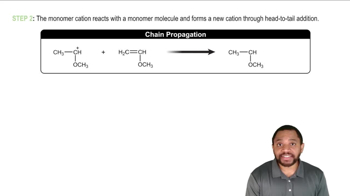
Describe the propagation step in cationic polymerization.
The monomer cation reacts with another monomer molecule, forming a new cation through head-to-tail addition.
What is meant by 'head-to-tail' addition in propagation?
It refers to the pi bond of a new monomer attacking the carbocation at the end of the growing chain.
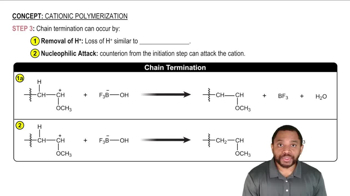
What are the two possible ways termination can occur in cationic polymerization?
Termination can occur by removal of H+ (similar to beta elimination) or by nucleophilic attack by a counter ion.
What is the result of termination by H+ removal?
The result is the formation of an alkene and regeneration of boron trifluoride and water.
How does nucleophilic attack terminate the polymerization?
A counter ion from the initiation step attacks the carbocation, neutralizing the charge and ending the chain.
What role does boron trifluoride play in the mechanism?
Boron trifluoride acts as a Lewis acid, helping to generate the H+ ion needed for initiation.
What happens to boron trifluoride at the end of the reaction?
Boron trifluoride is regenerated during the termination step.
What is the significance of the carbocation intermediate in this mechanism?
The carbocation intermediate allows for chain growth and is stabilized by electron-donating groups.
How does the mechanism of cationic polymerization exemplify electrophilic addition?
The mechanism involves an electrophile (H+) adding to an alkene, forming a carbocation that propagates the chain.