Organic Chemistry
My Course
Learn
Exam Prep
AI Tutor
Study Guides
Textbook Solutions
Flashcards
Explore
Try the app
My Course
Learn
Exam Prep
AI Tutor
Study Guides
Textbook Solutions
Flashcards
Explore
Try the app
Back
Catalytic Allylic Alkylation definitions
You can tap to flip the card.
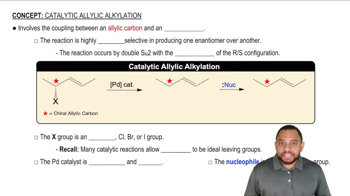
Allylic Carbon
You can tap to flip the card.
👆
Allylic Carbon
A carbon atom adjacent to a carbon-carbon double bond, often serving as a reactive site in coupling reactions.
Track progress
Control buttons has been changed to "navigation" mode.
1/14
Related flashcards
Related practice
Recommended videos
Catalytic Allylic Alkylation quiz
Catalytic Allylic Alkylation
15 Terms
27. Transition Metals
6 topics
14 problems
Chapter
Johnny
3:13
Catalytic Allylic Alkylation Example 1
2
views
3:21
Catalytic Allylic Alkylation Concept 1
1
views
Terms in this set (14)
Hide definitions
Allylic Carbon
A carbon atom adjacent to a carbon-carbon double bond, often serving as a reactive site in coupling reactions.
Enolate
A resonance-stabilized anion formed by deprotonation at the alpha position of a carbonyl compound, acting as a nucleophile.
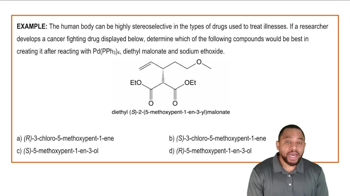
Stereoselectivity
A reaction preference for forming one stereoisomer over another, often resulting in a single enantiomer.
Enantiomer
A non-superimposable mirror image molecule, differing in spatial arrangement and optical activity.
Double SN2 Mechanism
A two-step nucleophilic substitution process involving consecutive backside attacks, leading to retention of configuration.
Retention of Configuration
A process where the spatial arrangement of atoms around a chiral center remains unchanged after a reaction.
Inversion of Configuration
A change in the spatial arrangement at a chiral center, typically resulting from a single SN2 reaction.
Palladium Catalyst
A transition metal complex that facilitates bond formation and selectivity in organic transformations.
Ligand
An atom or group attached to a central metal atom, influencing the reactivity and selectivity of a catalyst.
Leaving Group
An atom or group that departs with an electron pair during a substitution reaction, enabling nucleophilic attack.
Halogen
A group 17 element, such as chlorine, bromine, or iodine, commonly serving as a leaving group in organic reactions.
Ester
A functional group derived from an acid and an alcohol, often acting as a leaving group in catalytic processes.
Triphenylphosphine
An organophosphorus compound frequently used as a ligand in palladium-catalyzed reactions.
Nucleophile
A species with a lone pair or pi electrons, capable of donating electrons to form a new covalent bond.