Organic Chemistry
My Course
Learn
Exam Prep
AI Tutor
Study Guides
Textbook Solutions
Flashcards
Explore
Try the app
My Course
Learn
Exam Prep
AI Tutor
Study Guides
Textbook Solutions
Flashcards
Explore
Try the app
Back
Catabolism of Fats: Glycerol Metabolism definitions
You can tap to flip the card.
Glycerol Metabolism
You can tap to flip the card.
👆
Glycerol Metabolism
Pathway converting a lipid-derived molecule into glycolytic intermediates for energy production.
Track progress
Control buttons has been changed to "navigation" mode.
1/15
Related flashcards
Recommended videos
Catabolism of Fats: Glycerol Metabolism quiz
Catabolism of Fats: Glycerol Metabolism
15 Terms
1:02
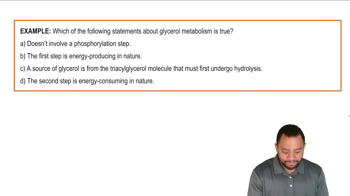
Glycerol Metabolism Example 1
1
views
1:39
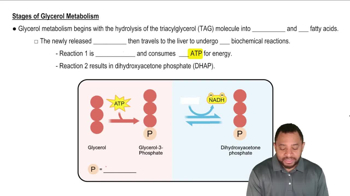
Glycerol Metabolism Concept 2
1
views
1:13
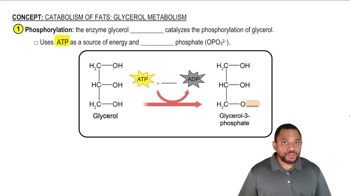
Glycerol Metabolism Concept 3
2
views
Terms in this set (15)
Hide definitions
Glycerol Metabolism
Pathway converting a lipid-derived molecule into glycolytic intermediates for energy production.
Triacylglycerol
A lipid molecule hydrolyzed to yield fatty acids and a three-carbon alcohol for further catabolism.
Hydrolysis
Chemical process breaking down large lipid molecules into smaller components using water.
Glycerol
A three-carbon alcohol released from fats, serving as a substrate for energy-yielding pathways.
Fatty Acid
Long hydrocarbon chains released from lipids, distinct from the three-carbon alcohol in fat breakdown.
Glycerol 3-Phosphate
A phosphorylated intermediate formed from a three-carbon alcohol, entering oxidation steps.
Phosphorylation
Addition of an inorganic phosphate group to a molecule, often using ATP and catalyzed by a kinase.
Glycerol Kinase
Enzyme catalyzing the transfer of a phosphate group from ATP to a three-carbon alcohol.
Dihydroxyacetone Phosphate
A glycolytic intermediate produced from the oxidation of a phosphorylated three-carbon alcohol.
Dehydrogenase
Enzyme facilitating the oxidation of substrates by transferring electrons to NAD+.
NAD+
A coenzyme acting as an electron acceptor, reduced during oxidation reactions to form NADH.
NADH
A high-energy electron carrier generated during substrate oxidation, later used for ATP synthesis.
Glycolysis
Metabolic pathway converting glucose or intermediates into pyruvate, yielding ATP and NADH.
Pyruvate
Three-carbon end product of glycolysis, serving as a substrate for aerobic respiration.
Acetyl CoA
A central metabolic intermediate formed from pyruvate, entering the citric acid cycle for further energy extraction.