Organic Chemistry
My Course
Learn
Exam Prep
AI Tutor
Study Guides
Textbook Solutions
Flashcards
Explore
Try the app
My Course
Learn
Exam Prep
AI Tutor
Study Guides
Textbook Solutions
Flashcards
Explore
Try the app
Back
Catabolism of Carbohydrates: Glycolysis definitions
You can tap to flip the card.
Glycolysis
You can tap to flip the card.
👆
Glycolysis
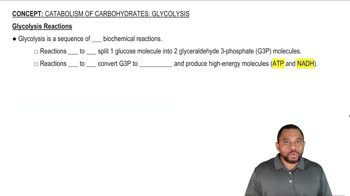
A ten-step metabolic pathway converting glucose to pyruvate, generating ATP and NADH, and involving sequential enzyme-catalyzed reactions.
Track progress
Control buttons has been changed to "navigation" mode.
1/15
Related flashcards
Recommended videos
Catabolism of Carbohydrates: Glycolysis quiz
Catabolism of Carbohydrates: Glycolysis
12 Terms
2:20
Glycolysis Reaction 6
2
views
00:58
Glycolysis Reactions
3
views
3:11
Glycolysis Reaction 4
4
views
Terms in this set (15)
Hide definitions
Glycolysis
A ten-step metabolic pathway converting glucose to pyruvate, generating ATP and NADH, and involving sequential enzyme-catalyzed reactions.
Pyruvate
The three-carbon end product of glycolysis, formed after a series of transformations from glucose, and a key metabolite for further energy production.
ATP
A high-energy molecule produced during glycolysis, serving as the main energy currency for cellular processes.
NADH
A reduced coenzyme generated in glycolysis, crucial for transferring electrons to the electron transport chain.
Phosphorylation
The addition of a phosphate group to a substrate, often using ATP, to activate or modify molecules during glycolysis.
Isomerization
A rearrangement of atoms within a molecule, converting one isomer to another, as seen in several glycolytic steps.
Glyceraldehyde 3 Phosphate
A three-carbon intermediate produced from glucose cleavage, central to the energy-yielding phase of glycolysis.
Dihydroxyacetone Phosphate
A three-carbon glycolytic intermediate that is isomerized to G3P, ensuring both products of glucose cleavage enter energy extraction steps.
Enediol Intermediate
A transient structure with a double bond between two carbons, each bearing a hydroxyl group, facilitating isomerization in glycolysis.
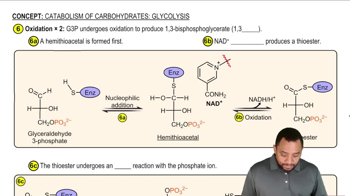
Thioester
A high-energy intermediate formed during oxidation steps, linking a carbonyl group to a sulfur atom, enabling phosphate transfer.
Nucleophilic Acyl Substitution
A reaction mechanism where a nucleophile replaces a leaving group on a carbonyl carbon, crucial for phosphate transfers in glycolysis.
Tautomerization
A chemical process involving the shift of a hydrogen and a double bond, interconverting keto and enol forms during glycolysis.
Phosphoenolpyruvate
A high-energy glycolytic intermediate with a phosphate group and an enol structure, serving as a phosphate donor to ADP.
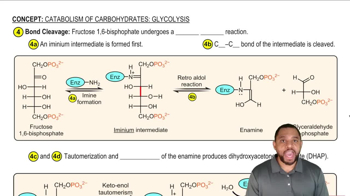
Retro Aldol Reaction
A bond cleavage mechanism splitting a six-carbon sugar into two three-carbon fragments during glycolysis.
Mutorotation
The interconversion between alpha and beta anomers of a sugar, enabling proper substrate configuration for phosphorylation.