Back

Carbon NMR quiz

Control buttons has been changed to "navigation" mode.
1/15
  • What isotope does Carbon-13 NMR detect?

    Carbon-13 NMR detects the carbon-13 isotope.
  • Why does Carbon-13 NMR provide less information than Proton NMR?

    It provides less information due to the low natural abundance of carbon-13 isotopes.
  • What is the natural abundance of carbon-13 in nature?

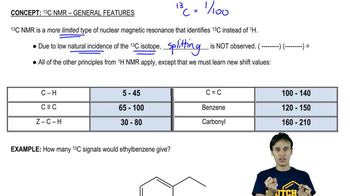
    About 1 out of every 100 carbon atoms is a carbon-13 isotope.
  • Why is splitting not observed in Carbon-13 NMR spectra?

    Splitting is not observed because the probability of two carbon-13 atoms being adjacent is extremely low.
  • What is the probability of two adjacent carbon-13 atoms in a molecule?

    The probability is about 1 in 10,000.
  • What major difference exists between Proton NMR and Carbon-13 NMR regarding splitting?

    Proton NMR shows splitting, but Carbon-13 NMR does not.
  • What does Carbon-13 NMR detect instead of hydrogens?

    It detects carbon atoms.
  • How do the chemical shift values in Carbon-13 NMR compare to Proton NMR?

    The order of chemical shifts is the same, but the absolute values are different.
  • What is the typical range of chemical shifts in Carbon-13 NMR?

    The range is from about 0 to 210.
  • Are students usually required to memorize Carbon-13 NMR shift values?

    No, memorizing these values is generally not required.
  • Which functional groups appear in the same order in both Proton and Carbon-13 NMR?

    Alkanes, alkynes, electronegatives, alkenes, benzene, and carbonyls appear in the same order.
  • Why do professors often not emphasize Carbon-13 NMR shift values?

    Because Carbon-13 NMR is less useful as an analytical method compared to Proton NMR.
  • What should students be familiar with regarding Carbon-13 NMR shifts?

    Students should be familiar with the general order of shifts, not the exact values.
  • How is the Carbon-13 NMR instrument calibrated compared to Proton NMR?

    It is calibrated differently, resulting in different shift values.
  • What is a key similarity between Proton NMR and Carbon-13 NMR?

    The major themes and order of chemical shifts are similar in both techniques.