Back

Barrier To Rotation definitions

Control buttons has been changed to "navigation" mode.
1/14
  • Barrier to Rotation

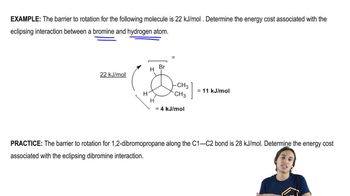
    Energy required to twist a molecule around a bond, influenced by interactions between substituents.
  • Eclipsed Interaction

    Arrangement where atoms or groups on adjacent carbons align, causing increased energy due to repulsion.
  • Gauche Interaction

    Staggered conformation where two bulky groups are 60° apart, leading to moderate energy increase.
  • Torsional Strain

    Destabilization from eclipsed bonds, resulting from electron repulsion between adjacent atoms or groups.
  • Methyl Group

    A bulky substituent, CH3, whose interactions significantly affect rotational energy barriers.
  • Hydrogen Atom

    A small substituent whose eclipsed interactions contribute less to rotational energy than larger groups.
  • Energy Cost

    The specific amount of energy, in kilojoules per mole, needed for a particular rotational interaction.
  • Kilojoules per Mole

    Unit expressing the energy required for molecular interactions during rotation.
  • Anti Conformation

    The most stable arrangement where bulky groups are opposite each other, minimizing repulsion.
  • Staggered Conformation

    A spatial arrangement where groups on adjacent carbons are as far apart as possible, reducing strain.
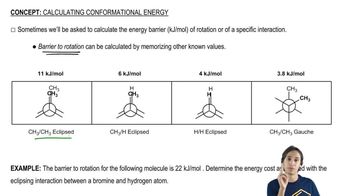
  • Eclipsed Methyl-Methyl Interaction

    Highest energy overlap, costing 11 kJ/mol, due to two large groups directly aligned.
  • Eclipsed Methyl-Hydrogen Interaction

    Intermediate energy overlap, costing 6 kJ/mol, from a large and a small group aligning.
  • Eclipsed Hydrogen-Hydrogen Interaction

    Lowest energy eclipsed overlap, costing 4 kJ/mol, from two small groups aligning.
  • Gauche Methyl-Methyl Interaction

    Staggered but close arrangement of two large groups, costing 3.8 kJ/mol, nearly matching eclipsed hydrogen interaction.