Back

Anaerobic Respiration definitions

Control buttons has been changed to "navigation" mode.
1/15
  • Anaerobic Respiration

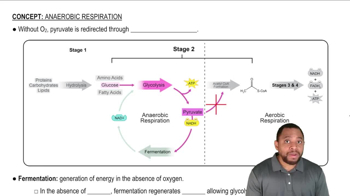
    Energy-generating process occurring without oxygen, redirecting pyruvate through fermentation instead of the citric acid cycle.
  • Fermentation

    Metabolic pathway that regenerates NAD+ from NADH, enabling glycolysis to persist in oxygen-limited environments.
  • Glycolysis

    Initial breakdown of glucose into pyruvate, producing ATP and NADH, and serving as the entry point for fermentation.
  • Pyruvate

    Three-carbon molecule formed from glycolysis, serving as a substrate for fermentation when oxygen is absent.
  • NAD+

    Electron carrier regenerated during fermentation, essential for the continuation of glycolysis.
  • NADH

    Reduced electron carrier produced in glycolysis, oxidized back to NAD+ during fermentation.
  • Lactate Fermentation

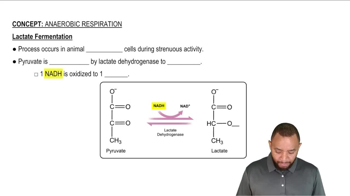
    Process in animal muscle cells converting pyruvate to lactate, especially during strenuous activity.
  • Lactate Dehydrogenase

    Enzyme catalyzing the reversible reduction of pyruvate to lactate, coupled with NADH oxidation.
  • Alcohol Fermentation

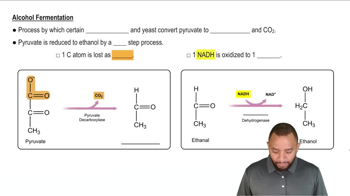
    Two-step process in yeast and bacteria converting pyruvate to ethanol and carbon dioxide.
  • Pyruvate Decarboxylase

    Enzyme facilitating the removal of a carboxyl group from pyruvate, releasing carbon dioxide.
  • Alcohol Dehydrogenase

    Enzyme reducing an aldehyde intermediate to ethanol, coupled with NADH oxidation.
  • Decarboxylation

    Chemical reaction involving the loss of a carbon dioxide molecule from a substrate, forming an aldehyde.
  • Aldehyde

    Intermediate formed after decarboxylation of pyruvate, subsequently reduced to ethanol.
  • Ethanol

    Two-carbon alcohol produced as a final product in alcohol fermentation by yeast and bacteria.
  • Carbon Dioxide

    Gaseous byproduct released during the decarboxylation step of alcohol fermentation.