Skip to main content
Organic Chemistry
My Course
Learn
Exam Prep
AI Tutor
Study Guides
Textbook Solutions
Flashcards
Explore
Try the app
My Course
Learn
Exam Prep
AI Tutor
Study Guides
Textbook Solutions
Flashcards
Explore
Try the app
Back
Allylic Bromination definitions
You can tap to flip the card.
Allylic Position
You can tap to flip the card.
👆
Allylic Position
A carbon atom directly adjacent to a double bond, often targeted due to the stability of resulting radicals.
Track progress
Control buttons has been changed to "navigation" mode.
1/15
Related flashcards
Related practice
Recommended videos
Allylic Bromination quiz
Allylic Halogenation
15 Terms
Allylic Bromination
11. Radical Reactions
8 problems
Topic
Johnny
11. Radical Reactions - Part 1 of 2
4 topics
11 problems
Chapter
Johnny
11. Radical Reactions - Part 2 of 2
5 topics
13 problems
Chapter
Johnny
04:28
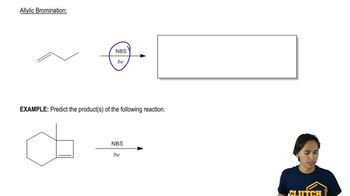
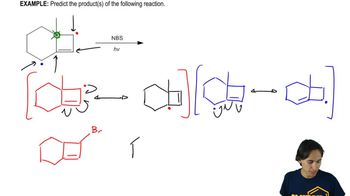
Predict the product(s) of the following reaction.
5
views
00:54
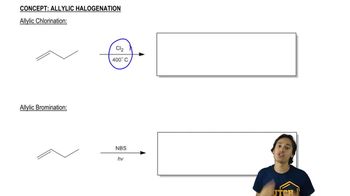
Mechanism of Allylic Bromination.
8
views
00:48
The products of Allylic Chlorination.
6
views
Terms in this set (15)
Hide definitions
Allylic Position
A carbon atom directly adjacent to a double bond, often targeted due to the stability of resulting radicals.
Radical Stability
A trend where certain radicals, such as those next to double bonds, are more stable due to resonance effects.
Resonance
A phenomenon where electrons or radicals are delocalized over multiple atoms, stabilizing intermediates and allowing multiple products.
Initiation Step
The phase where diatomic halogen molecules split to generate radicals, starting the chain reaction.
Propagation Step
The sequence where radicals abstract hydrogen atoms and generate new radicals, continuing the reaction.
Termination Step
The phase where radicals combine to form stable, non-radical products, ending the chain process.
NBS
A reagent, N-bromosuccinimide, used to provide low concentrations of bromine for selective allylic bromination.
Mixture of Products
A result of resonance in allylic radicals, leading to halogenation at multiple positions and more than one product.
Diatomic Halogen
A molecule consisting of two identical halogen atoms, such as Br2 or Cl2, used as a source of radicals.
Allylic Radical
A radical species formed at a position adjacent to a double bond, stabilized by resonance.
Selective Halogenation
A process where halogenation occurs preferentially at the most stable radical site, often the allylic position.
Benzylic Radical
A radical adjacent to an aromatic ring, noted for high stability similar to allylic radicals.
400 Degrees Celsius
A typical temperature used for allylic chlorination with Cl2, promoting radical formation.
Light
An energy source used to initiate radical formation, especially in reactions with NBS or bromine.
Hydrogen Abstraction
A step where a radical removes a hydrogen atom from the allylic position, generating a new radical.
 BackBack
 04:28
04:28