Back

Alkyne Oxidative Cleavage quiz

Control buttons has been changed to "navigation" mode.
1/15
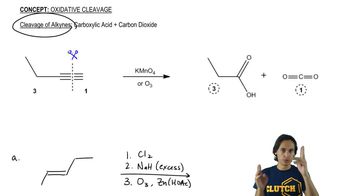
  • What is the process called when a triple bond is split into two parts using strong oxidizing agents?

    This process is called cleavage of alkynes.
  • Which reagents are commonly used for the oxidative cleavage of alkynes?

    Potassium permanganate (KMnO4) and ozone are commonly used.
  • What analogy is used to describe the splitting of an alkyne in oxidative cleavage?

    The analogy of cutting with scissors is used.
  • How do you determine the products formed from alkyne cleavage?

    You look at the number of carbons on each side of the triple bond.
  • What is the product when a three-carbon chain is cleaved from an alkyne?

    A three-carbon carboxylic acid is formed.
  • What happens to a single carbon chain after alkyne cleavage?

    It is fully oxidized to carbon dioxide (CO2).
  • What type of compounds are formed from carbon chains longer than one carbon after oxidative cleavage?

    Carboxylic acids are formed.
  • What is the product when a one-carbon fragment is cleaved from an alkyne?

    The product is carbon dioxide gas.
  • Are triple bonds sensitive to oxidation?

    Yes, triple bonds are very sensitive to oxidation.
  • Do potassium permanganate and ozone produce different products in alkyne cleavage?

    No, they produce the same products.
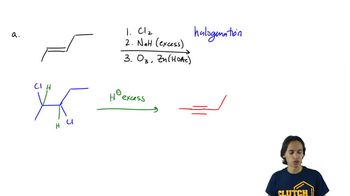
  • What should you do to predict the end products of alkyne cleavage?

    Practice multi-step synthesis with different reagents.
  • What is the result of cleaving an alkyne with three carbons on one side and one carbon on the other?

    You get a three-carbon carboxylic acid and carbon dioxide.
  • What happens to the carbon atoms during oxidative cleavage of alkynes?

    Each side of the triple bond forms a separate product based on the number of carbons.
  • What is the significance of the number of carbons on each side of the triple bond in alkyne cleavage?

    It determines whether the product is a carboxylic acid or carbon dioxide.
  • What is encouraged for mastering alkyne oxidative cleavage reactions?

    Practicing multi-step synthesis and predicting products with different reagents is encouraged.