Skip to main content
Organic Chemistry
My Course
Learn
Exam Prep
AI Tutor
Study Guides
Textbook Solutions
Flashcards
Explore
Try the app
My Course
Learn
Exam Prep
AI Tutor
Study Guides
Textbook Solutions
Flashcards
Explore
Try the app
Back
Alkane Halogenation definitions
You can tap to flip the card.
Alkane
You can tap to flip the card.
👆
Alkane
A saturated hydrocarbon containing only single bonds, often serving as the starting material in radical halogenation.
Track progress
Control buttons has been changed to "navigation" mode.
1/13
Related flashcards
Related practice
Recommended videos
Alkane Halogenation quiz
Alkane Halogenation
15 Terms
Alkane Halogenation
14. Synthetic Techniques
1 problem
Topic
Ernest
Retrosynthesis
14. Synthetic Techniques
5 problems
Topic
Nicole
14. Synthetic Techniques
5 topics
13 problems
Chapter
Johnny
02:47
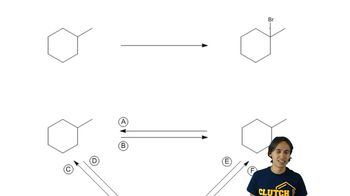
Functionalizing Alkanes
5
views
Terms in this set (13)
Hide definitions
Alkane
A saturated hydrocarbon containing only single bonds, often serving as the starting material in radical halogenation.
Halogenation
A process introducing a halogen atom into a molecule, commonly used to functionalize otherwise unreactive hydrocarbons.
Radical Halogenation
A reaction mechanism involving free radicals to substitute a hydrogen atom in an alkane with a halogen.
Alkyl Halide
A compound formed when a halogen atom replaces a hydrogen atom in an alkane, often used as an intermediate in synthesis.
Bromine
A halogen element frequently used with heat or light to selectively introduce a bromine atom into an alkane.
Chlorination
A halogenation method using chlorine, effective mainly when the molecule contains only one type of hydrogen.
Hydrogen
The atom in alkanes that is replaced during halogenation, with selectivity depending on its chemical environment.
Retrosynthesis
A problem-solving approach where a target molecule is deconstructed into simpler precursors to plan a synthetic route.
Reagent
A chemical substance or mixture used to cause a transformation in a synthetic sequence, crucial for multi-step synthesis.
Multi-step Synthesis
A sequence of chemical reactions designed to construct a complex molecule from simpler starting materials.
Functionalization
The introduction of a functional group into a molecule, increasing its chemical reactivity or utility.
Heat
A condition often required to initiate radical halogenation, providing energy for bond cleavage.
Light
An alternative to heat, used to generate radicals during the halogenation of alkanes.
 BackBack


 02:47
02:47