Skip to main content
Organic Chemistry
My Course
Learn
Exam Prep
AI Tutor
Study Guides
Textbook Solutions
Flashcards
Explore
Try the app
My Course
Learn
Exam Prep
AI Tutor
Study Guides
Textbook Solutions
Flashcards
Explore
Try the app
Back
Acid-Base Properties of Nitrogen Heterocycles definitions
You can tap to flip the card.
Aromatic Heterocyclic Amine
You can tap to flip the card.
👆
Aromatic Heterocyclic Amine
A nitrogen-containing ring system with delocalized electrons, displaying unique weak basicity due to orbital and electronic effects.
Track progress
Control buttons has been changed to "navigation" mode.
1/13
Related flashcards
Related practice
Recommended videos
Acid-Base Properties of Nitrogen Heterocycles quiz
Acid-Base Properties of Nitrogen Heterocycles
15 Terms
Acid-Base Properties of Nitrogen Heterocycles
27. Heterocycles
5 problems
Topic
Reactions of Pyrrole, Furan, and Thiophene
27. Heterocycles
5 problems
Topic
27. Heterocycles - Part 1 of 2
4 topics
12 problems
Chapter
27. Heterocycles - Part 2 of 2
4 topics
12 problems
Chapter
Guided course
2:07
Acid-Base Properties of Nitrogen Heterocycles Concept 1
4
views
Guided course
1:37
Acid-Base Properties of Nitrogen Heterocycles Concept 2
3
views
Guided course
2:01
Acid-Base Properties of Nitrogen Heterocycles Example 1
1
views
Terms in this set (13)
Hide definitions
Aromatic Heterocyclic Amine
A nitrogen-containing ring system with delocalized electrons, displaying unique weak basicity due to orbital and electronic effects.
Hybridization
The mixing of atomic orbitals in nitrogen, influencing the s character and thus the basicity of the heterocycle.
s Character
The proportion of s orbital in a hybrid orbital; higher values increase electronegativity and reduce basicity.
sp2 Hybridization
A state with 33% s character, making nitrogen more electronegative and less basic compared to sp3.
sp3 Hybridization
A state with 25% s character, resulting in lower electronegativity and stronger basicity for nitrogen.
Aromaticity
A property of cyclic molecules with delocalized pi electrons, affecting the availability of nitrogen lone pairs for basicity.
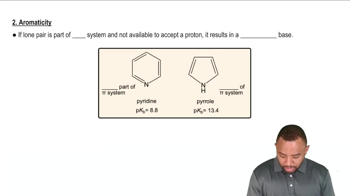
Lone Pair
A pair of valence electrons on nitrogen that may or may not participate in aromatic pi systems, impacting basicity.
pKb
A quantitative measure of base strength; higher values indicate weaker bases in nitrogen heterocycles.
Pi System
A network of delocalized electrons in a ring, which can include or exclude nitrogen lone pairs, altering basicity.
Hückel’s Rule
A guideline stating that aromatic rings must have 4n+2 pi electrons, determining aromaticity and lone pair involvement.
Pyridine
A six-membered aromatic ring with nitrogen, where the lone pair is not part of the pi system, resulting in higher basicity.
Pyrrole
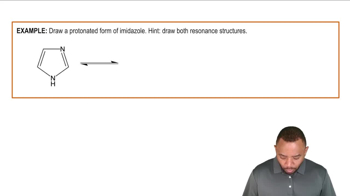
A five-membered aromatic ring with nitrogen, where the lone pair is part of the pi system, leading to weaker basicity.
Electronegativity
The tendency of nitrogen to attract electrons, increased by greater s character, thus reducing basicity.
 BackBack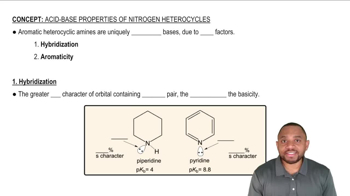
 2:07
2:07