Skip to main content
Organic Chemistry
My Course
Learn
Exam Prep
AI Tutor
Study Guides
Textbook Solutions
Flashcards
Explore
Try the app
My Course
Learn
Exam Prep
AI Tutor
Study Guides
Textbook Solutions
Flashcards
Explore
Try the app
Back
Acetylide definitions
You can tap to flip the card.
Terminal Alkyne
You can tap to flip the card.
👆
Terminal Alkyne
A hydrocarbon with a triple bond at the end of the chain, featuring a hydrogen directly bonded to a triple-bonded carbon.
Track progress
Control buttons has been changed to "navigation" mode.
1/15
Related flashcards
Related practice
Recommended videos
Acetylide quiz
Alkynide Synthesis
15 Terms
Acetylide
9. Alkenes and Alkynes
7 problems
Topic
Johnny
Hydrogenation of Alkynes
9. Alkenes and Alkynes
7 problems
Topic
Johnny
9. Alkenes and Alkynes - Part 1 of 2
5 topics
11 problems
Chapter
Ernest
9. Alkenes and Alkynes - Part 2 of 2
5 topics
11 problems
Chapter
Johnny
04:19
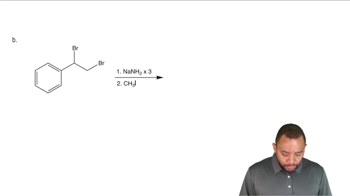
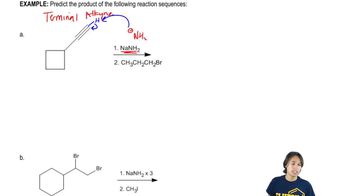
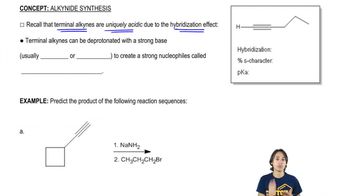
Understanding how to convert terminal alkynes to alkynides.
4
views
02:57
Using double dehydrohalogenation to perform alkynide synthesis.
4
views
03:48
The mechanism of alkynide synthesis.
3
views
Terms in this set (15)
Hide definitions
Terminal Alkyne
A hydrocarbon with a triple bond at the end of the chain, featuring a hydrogen directly bonded to a triple-bonded carbon.
Hybridization Effect
An influence on acidity where increased s-character in a hybrid orbital leads to greater acidity of a hydrogen atom.
sp Hybridization
A state where a carbon forms two groups, resulting in 50% s-character and contributing to higher acidity.
pKa
A numerical value indicating the acidity of a compound; lower values mean stronger acids, especially notable for hydrocarbons.
Sodium Amide
A strong, small base used to deprotonate terminal alkynes, generating nucleophilic species for further reactions.
Sodium Alkynide
A negatively charged species formed by deprotonating a terminal alkyne, often paired with a sodium ion and acting as a nucleophile.
Nucleophilic Substitution
A reaction where a nucleophile replaces a leaving group, such as a halide, on a carbon atom.
Primary Alkyl Halide
An alkyl halide where the halogen is attached to a carbon bonded to only one other carbon, favoring SN2 reactions.
SN2 Reaction
A one-step substitution mechanism where a nucleophile attacks a carbon, displacing a leaving group simultaneously.
Multistep Synthesis
A sequence of chemical reactions designed to build complex molecules from simpler starting materials.
Dehydrohalogenation
A process where a base removes hydrogen and halide atoms from adjacent carbons, forming multiple bonds.
Vicinal Dihalide
A molecule with two halogen atoms attached to neighboring carbons, serving as a precursor for elimination reactions.
Beta Hydrogen
A hydrogen atom located on the carbon adjacent to the one bearing a leaving group, targeted during elimination.
Leaving Group
An atom or group, such as a halide, that departs with a pair of electrons during a substitution or elimination reaction.
Internal Alkyne
A molecule with a triple bond located between two carbons, not at the end of the carbon chain.
 BackBack

 04:19
04:19