Back

Acetal Protecting Group quiz

Control buttons has been changed to "navigation" mode.
1/15
  • What functional groups do acetals protect in organic synthesis?

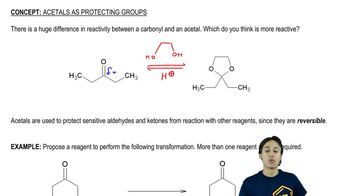
    Acetals are used to protect sensitive carbonyl groups, specifically aldehydes and ketones.
  • Why are carbonyl groups considered highly reactive?

    Carbonyl groups are highly reactive due to the partial positive charge on the carbonyl carbon, making them susceptible to attack by various reagents.
  • How does the reactivity of acetals compare to that of ethers?

    Acetals are about as unreactive as ethers, which means they do not react with most reagents except under combustion.
  • What is the main advantage of converting a carbonyl group into an acetal during a synthesis?

    The main advantage is that the acetal is much less reactive, allowing other reactions to occur elsewhere on the molecule without affecting the protected carbonyl.
  • What reagents are typically used to convert a carbonyl group into an acetal?

    A carbonyl group is converted into an acetal using an alcohol (or diol for cyclic acetals) and an acid catalyst.
  • Why are acetals considered good protecting groups for carbonyls?

    Acetals are good protecting groups because they are stable under many reaction conditions and can be easily removed to regenerate the original carbonyl.
  • What is the process called when an acetal is converted back to a carbonyl group?

    The process is called hydrolysis, which regenerates the original carbonyl group from the acetal.
  • Why is a one-step reaction often insufficient for transforming a molecule with a sensitive carbonyl group?

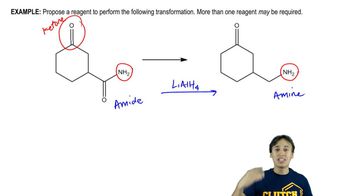
    A one-step reaction is likely to fail because the carbonyl group is too reactive and may undergo unwanted side reactions.
  • What type of bonds are present in acetals that make them less reactive than carbonyls?

    Acetals have dipoles located on sigma bonds, which are much harder to break than the pi bonds in carbonyls.
  • What is the general strategy for using an acetal protecting group in a multi-step synthesis?

    The strategy is to convert the carbonyl to an acetal, perform the desired reaction elsewhere, and then hydrolyze the acetal back to the carbonyl.
  • What happens if you try to perform a reaction on a molecule with an unprotected carbonyl group?

    The unprotected carbonyl group may react with reagents, leading to unwanted side reactions or destruction of the functional group.
  • What is required to form a cyclic acetal from a carbonyl group?

    A cyclic diol and an acid catalyst are required to form a cyclic acetal from a carbonyl group.
  • How does the equilibrium between a carbonyl and its acetal form affect synthetic planning?

    The equilibrium allows for reversible protection and deprotection, enabling selective reactions elsewhere on the molecule.
  • What is the role of acid in the formation of acetals from carbonyls?

    Acid acts as a catalyst to facilitate the conversion of carbonyls to acetals.
  • Why is it important to consider the sequence of reactions when using protecting groups?

    The sequence is important because direct reactions may fail or cause side reactions, so protecting groups allow for selective transformations in a controlled order.