Back

1H NMR:Number of Signals definitions

Control buttons has been changed to "navigation" mode.
1/15
  • Proton NMR

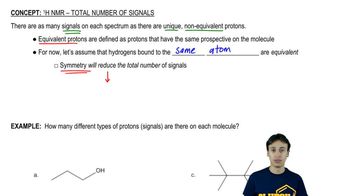
    A technique that reveals the number of unique hydrogen environments in a molecule by displaying distinct signals.
  • Signal

    A peak on the spectrum representing a unique set of non-equivalent hydrogens in a molecule.
  • Equivalent Protons

    Hydrogens sharing identical molecular environments, resulting in a single NMR signal.
  • Non-equivalent Protons

    Hydrogens in distinct environments, each producing a separate NMR signal.
  • Symmetry

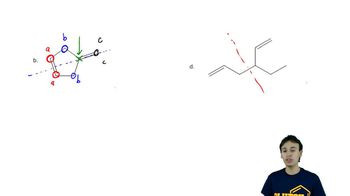
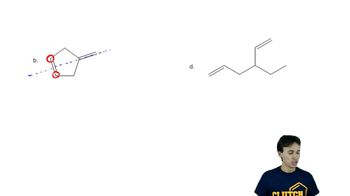
    A molecular feature that causes certain hydrogens to share environments, reducing the number of NMR signals.
  • Methyl Group

    A group containing three hydrogens bonded to the same carbon, making them equivalent in NMR analysis.
  • Electronegative Atom

    An atom like oxygen that alters the electronic environment of nearby hydrogens, affecting their NMR signals.
  • Deshielding

    A phenomenon where hydrogens near electronegative atoms experience reduced electron density, shifting their signals downfield.
  • Plane of Symmetry

    An imaginary division in a molecule that creates mirrored halves, leading to equivalent hydrogens.
  • Downfield

    A region of the NMR spectrum where deshielded hydrogens appear, typically at higher chemical shift values.
  • Upfield

    A region of the NMR spectrum where shielded hydrogens appear, typically at lower chemical shift values.
  • Hydrogen Environment

    The unique electronic and spatial context surrounding a hydrogen, determining its NMR signal.
  • Peak

    A graphical representation on the NMR spectrum corresponding to a specific hydrogen environment.
  • Carbon

    An atom to which hydrogens may be attached, influencing their equivalence and NMR signals based on its neighbors.
  • Oxygen

    A highly electronegative atom that, when bonded to hydrogen, creates a distinct NMR signal due to its unique environment.